











Flat to Let in Warsaw 2026 – Districts, Floor Areas, Prices
 Author: Tacjana MasiukiewiczInvesting~13 min read
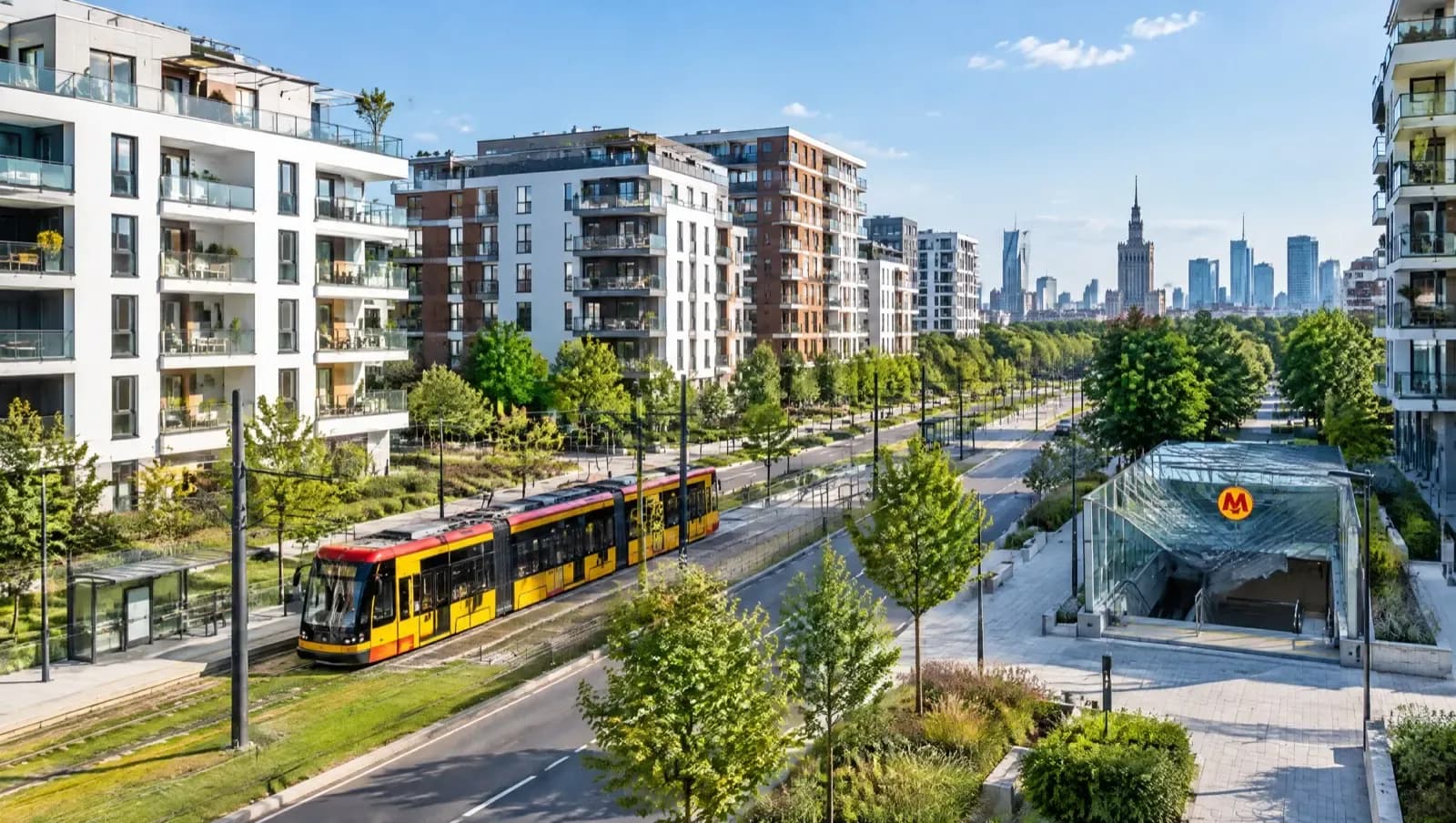
The best place to buy a flat to let in Warsaw is where two things meet: steady tenant demand (metro, universities, offices) and a price per metre that does not "eat" the rent. According to TM Invest offer data as at 27.09.2026, a metre of a new flat costs from about 14,1 thousand PLN (median in Białołęka) to 33,7 thousand PLN (City Centre), and the average rental rate in Warsaw according to the NBP (National Bank of Poland) is 85,1 PLN/m² a month. Below we set out the districts, floor areas and estimated gross yield – with an example of how much is left "in hand" after costs.
Key facts
- The average rental rate in Warsaw in the first quarter of 2026 was, according to the NBP, 85,1 PLN/m² a month (excluding service charges and utilities) – 3,3% more than a year earlier.
- In our offer the median price of a new flat in Warsaw is 18 000 PLN/m² (2237 available flats in 73 developments).
- At the average NBP rate, gross yield ranges from about 7,2% (Białołęka) to about 3,0% (City Centre) – the more expensive the metre, the lower the return from rent.
- The NBP estimates the capitalisation rate for an average flat in Warsaw at 5,95%, which means a payback period of about 16 years and 10 months.
- After vacancy, the 8,5% flat tax and finishing costs, the real rate of return is clearly lower than the "gross from the advert" – in our example by 1,2–2,3 percentage points.
What drives rental demand in Warsaw?
A tenant rarely chooses a flat "in a district" – they choose the journey time to work or university. That is why, when buying to let, three demand magnets matter above all:
- Metro. Line M1 runs through Mokotów, the City Centre, Żoliborz and Bielany (stations from Słodowiec to Młociny), and M2 through Bemowo, Wola, the City Centre, Praga-Północ and Targówek. A flat within walking distance of a station is easier to let and less likely to "stand empty" between tenants. We describe the details of stations and estates in the guides new flats in Mokotów and new flats in Wola.
- Offices. The largest clusters of office buildings are around Rondo Daszyńskiego in Wola, Służewiec in Mokotów and the City Centre itself. Their employees are typical tenants of studios and two-room flats.
- Universities. Students and young researchers look for units near campuses – among others in the City Centre (University of Warsaw, Warsaw University of Technology), in Mokotów (SGH Warsaw School of Economics), in Bielany (AWF, UKSW) and in Ursynów (SGGW).
Districts without a metro – Białołęka, Ursus or Włochy – also have their tenants: a commute by rail (for example the SKM in Ursus), tram or bus can be acceptable if the rent is lower than near a station. Such locations, however, require a closer check of the specific address: the walking time to a stop, the frequency of services and whether there are services nearby. You will find a general comparison of districts for living in the article best districts of Warsaw to live in.
Prices of flats to let in Warsaw – districts in our offer
The table below shows how much small flats – most often bought to let – cost in the ten districts where we have new developments. By "studio" we took a unit of up to 35 m², because developers describe the number of rooms in the smallest flats differently.
| District | Available flats | Median PLN/m² | Unit up to 35 m²: median price (from) | 2 rooms: median price (floor area) |
|---|---|---|---|---|
| Białołęka | 609 | 14 122 | 519 thousand PLN (from 298 thousand PLN) | 553 thousand PLN (39,1 m²) |
| Ursus | 122 | 15 726 | 538 thousand PLN (from 437 thousand PLN) | 568 thousand PLN (34,6 m²) |
| Targówek | 77 | 15 948 | none in the offer | 650 thousand PLN (39,2 m²) |
| Włochy | 156 | 17 650 | 573 thousand PLN (from 509 thousand PLN) | 789 thousand PLN (44,9 m²) |
| Praga-Południe | 268 | 18 600 | 624 thousand PLN (from 531 thousand PLN) | 737 thousand PLN (39,2 m²) |
| Praga-Północ | 19 | 19 000 | 523 thousand PLN (from 498 thousand PLN) | 713 thousand PLN (34,9 m²) |
| Bielany | 170 | 19 550 | 663 thousand PLN (from 515 thousand PLN) | 772 thousand PLN (39,0 m²) |
| Mokotów | 448 | 22 900 | 763 thousand PLN (from 495 thousand PLN) | 1,01 million PLN (40,3 m²) |
| Wola | 122 | 26 442 | 872 thousand PLN (from 702 thousand PLN) | 1,20 million PLN (43,6 m²) |
| City Centre | 78 | 33 700 | 917 thousand PLN (from 821 thousand PLN) | 1,40 million PLN (38,2 m²) |
The spread is huge: for the median two-room flat in Mokotów you could buy almost two units of similar size in Białołęka. We have the most units up to 35 m² in Białołęka (among others Osiedle Salvia and the completed Eco Berensona), in Praga-Południe (the Metro Art series and Osiedle PUR) and in the City Centre (Apartamenty Grzybowska 11). In Mokotów small flats are found among others in the Apartamenty Metro Wilanowska under construction (completion in the second quarter of 2028). We show a wider picture of prices in the capital in the article on new apartment prices in Warsaw.
Best districts to let in Warsaw – estimated gross yield
Gross yield is annual rent divided by the purchase price. The NBP gives rental rates only for the whole of Warsaw, so in the table we took the same average – 85,1 PLN/m² – for every district. In practice, in the centre and near the metro rents per metre are usually higher, and on the outskirts lower. That is why we added a column that reverses the question: what rent per metre you would have to get to earn 5% gross a year at the median prices in a given district.
| District | Median PLN/m² | Gross yield at 85,1 PLN/m² | Rent needed for 5% gross |
|---|---|---|---|
| Białołęka | 14 122 | 7,2% | 59 PLN/m² |
| Ursus | 15 726 | 6,5% | 66 PLN/m² |
| Targówek | 15 948 | 6,4% | 66 PLN/m² |
| Włochy | 17 650 | 5,8% | 74 PLN/m² |
| Praga-Południe | 18 600 | 5,5% | 78 PLN/m² |
| Praga-Północ | 19 000 | 5,4% | 79 PLN/m² |
| Bielany | 19 550 | 5,2% | 81 PLN/m² |
| Mokotów | 22 900 | 4,5% | 95 PLN/m² |
| Wola | 26 442 | 3,9% | 110 PLN/m² |
| City Centre | 33 700 | 3,0% | 140 PLN/m² |
The conclusion from the table: cheaper districts such as Białołęka and Ursus usually give higher gross yield, and more expensive ones – Mokotów, Wola, the City Centre – lower. In Białołęka a rent of about 59 PLN/m² is enough to reach 5% gross, while in the City Centre you would have to get about 140 PLN/m² – clearly more than the city average. This is not a rule without exceptions, though. More expensive locations near the metro and offices are usually easier to let and stand empty less often between tenants. A cheaper district with a long commute may in turn mean lower rent than the NBP average and a longer search for a tenant. How to calculate the rate of return step by step we show in the article rental yield of a flat.
A reference point may be the NBP estimate: for an average flat in Warsaw the central bank calculates the capitalisation rate at 5,95% (first quarter of 2026). The NBP, however, calculates it from average transaction prices across the whole market, not developers' offers, so a direct comparison with the table is indicative.
Looking for a flat to let in a specific district? We will help you choose a unit and compare developers' offers – for the buyer in most cases with no commission, because the developer usually pays our fee.
Example: how much will a flat in Białołęka really earn, and how much in Mokotów?
Let us compare two typical two-room flats from our offer of similar area: the median in Białołęka (39,1 m² for 553 358 PLN) and in Mokotów (40,3 m² for 1 013 989 PLN). We take the same assumptions for both:
- rent: 85,1 PLN/m² (NBP average for Warsaw), service charges and utilities paid by the tenant,
- finishing for letting: 2 000 PLN/m² plus 20 000 PLN for furniture and appliances (an assumption within the ranges described in the article on the cost of finishing a flat),
- notary and court costs: indicatively 4 thousand PLN (Białołęka) and 5 thousand PLN (Mokotów),
- one month of vacancy a year, 8,5% flat tax on revenue, property tax of about 50 PLN and 1 500 PLN a year for insurance and minor repairs.
| Item | Białołęka, 2 rooms | Mokotów, 2 rooms |
|---|---|---|
| Price of the flat | 553 358 PLN | 1 013 989 PLN |
| Finishing and furnishing | 98 200 PLN | 100 600 PLN |
| Transaction costs | about 4 000 PLN | about 5 000 PLN |
| Total outlay | 655 558 PLN | 1 119 589 PLN |
| Monthly rent | 3 327 PLN | 3 430 PLN |
| Revenue for 11 months | 36 602 PLN | 37 725 PLN |
| Flat tax 8,5% | −3 111 PLN | −3 207 PLN |
| Property tax, insurance, repairs | −1 550 PLN | −1 550 PLN |
| Net annual profit | 31 940 PLN | 32 968 PLN |
| Gross yield (rent × 12 ÷ price) | 7,2% | 4,1% |
| Net yield (profit ÷ total outlay) | 4,9% | 2,9% |
Both flats will bring similar rent in zlotys, but in Mokotów you have to tie up almost twice as much capital. It is worth running a sensitivity test, though: if in Białołęka you get not 85,1 but, say, 70 PLN/m², rent falls to about 2 737 PLN and net yield to about 4,0%. Conversely, a flat in Mokotów near the metro may achieve a rate higher than the city average. That is why, before buying, check current rental listings within a few hundred metres of the specific building, not the district average. We describe the rules of settling the flat tax in the article tax on flat rental.
Studio or 2 rooms to let in Warsaw?
A studio to let in Warsaw is the lowest entry threshold: in our offer units up to 35 m² start from about 298 thousand PLN (25 m² in the completed Eco Berensona in Białołęka) and about 437 thousand PLN in Ursus. Small flats, however, usually have a higher price per metre, and tenants change more often. Two rooms cost more, but can attract a couple or two flatmates and give more flexibility on resale.
In districts such as Białołęka, Ursus or Praga-Południe, a two-room flat of 35–40 m² costs in our offer about the same as or slightly more than a studio in the centre. You will find a detailed comparison of return and risk for both types of unit in the article studio or 2 rooms to let.
An investment flat in Warsaw – what to watch out for when choosing
- Completion date. A flat under construction does not earn until handover and finishing. A completed unit (in our Warsaw offer there are 673) will start to bring rent after a few months.
- Layout. Tenants value a separate bedroom, a window in the kitchen or a well-ventilated kitchenette, a balcony and space for a washing machine. A badly designed 38 m² will be harder to let than a functional 34 m².
- Parking space. Outside the centre, tenants with a car often ask about parking – in the City Centre and near the metro it matters less.
- Competition nearby. Large estates with hundreds of similar studios delivered at the same time can push rents down for several months.
- Form of letting. Long-term letting carries different risks and rules than short-term – it is worth deciding this before buying.
A broader look at whether a flat is a good investment for you at all is in our guide a flat as an investment. If you are also considering the secondary market, compare it with the article where to buy a flat to let in Wroclaw.
Frequently asked questions
Where to buy a flat to let in Warsaw?
The highest gross yield at the average rental rate is given by cheaper districts: Białołęka, Ursus and Targówek (about 6,4–7,2%). Mokotów, Wola and the City Centre give a lower return from rent (3–4,5%), but have the metro, offices and universities that ensure steady demand. The choice depends on whether you are betting on current income or ease of letting.
How much does a studio to let cost in Warsaw?
According to TM Invest offer data as at 27.09.2026, new flats up to 35 m² cost from about 298 thousand PLN in Białołęka. The median price of such a unit is about 519 thousand PLN in Białołęka, 624 thousand PLN in Praga-Południe, 763 thousand PLN in Mokotów and 917 thousand PLN in the City Centre.
What is the average rent per m² in Warsaw?
According to the NBP, the average rental rate for flats in Warsaw in the first quarter of 2026 was 85,1 PLN/m² a month, excluding service charges and utilities. That is a rise of 2,6% quarter on quarter and 3,3% year on year. For a 40 m² flat this gives about 3 400 PLN a month plus charges.
Is it worth buying an investment flat near the metro in Warsaw?
Proximity to the metro makes letting easier and shortens gaps between tenants, but flats near stations are more expensive, so yield from rent alone can be lower. It usually pays off when you get a rate clearly higher than the city average – check it in listings near the specific building.
How many years does a flat to let in Warsaw take to pay back?
The NBP estimates that at a capitalisation rate of 5,95% the payback period for an average Warsaw flat was about 16 years and 10 months in the first quarter of 2026. In our net example (4,9% in Białołęka, 2,9% in Mokotów) payback from rent alone would take about 20 and more than 30 years respectively – without allowing for changes in flat prices.
Summary
A flat to let in Warsaw can be bought both for about 500 thousand PLN in Białołęka or Ursus and for over a million in Mokotów or Wola. The yield table shows that cheaper districts usually give a higher gross return from rent and more expensive ones a lower one, but in exchange offer the metro, offices and universities, that is more stable demand. Before you decide, calculate the net return for a specific unit and check the real rents in its area.
Want to compare specific flats to let? We will select units within your budget and prepare a summary from several developments – for the buyer in most cases with no commission, because the developer usually pays our fee. You will also find all offers in the catalogue of new flats in Warsaw.
Legal position as at September 2026. The calculations are indicative, rest on the assumptions made and are not an investment recommendation or tax advice. Actual rent, costs and rate of return depend on the specific flat and the market situation.
Sources
- NBP, Information on housing prices and the situation on the residential and commercial real estate market in Poland in the first quarter of 2026 – rental rates, capitalisation rate and payback period for Warsaw.
- NBP, Quarterly information on the real estate market – archive of reports and the housing price database.
- Act on the Flat-Rate Income Tax on Certain Income of Individuals – consolidated text Dz.U. 2025 item 843 (Art. 12(1)(4)(a)).
- Podatki.gov.pl – settlement of rental income (recorded flat-rate tax).
- Act on Local Taxes and Fees – consolidated text Dz.U. 2025 item 707 (rate for residential buildings in Warsaw for 2026: 1,25 PLN/m²).
- Flat prices: TM Invest development catalogue, as at 27.09.2026.