










Stan Deweloperski: What Happens After the Handover
 Author: Tacjana MasiukiewiczFinishing and fitting out~14 min read
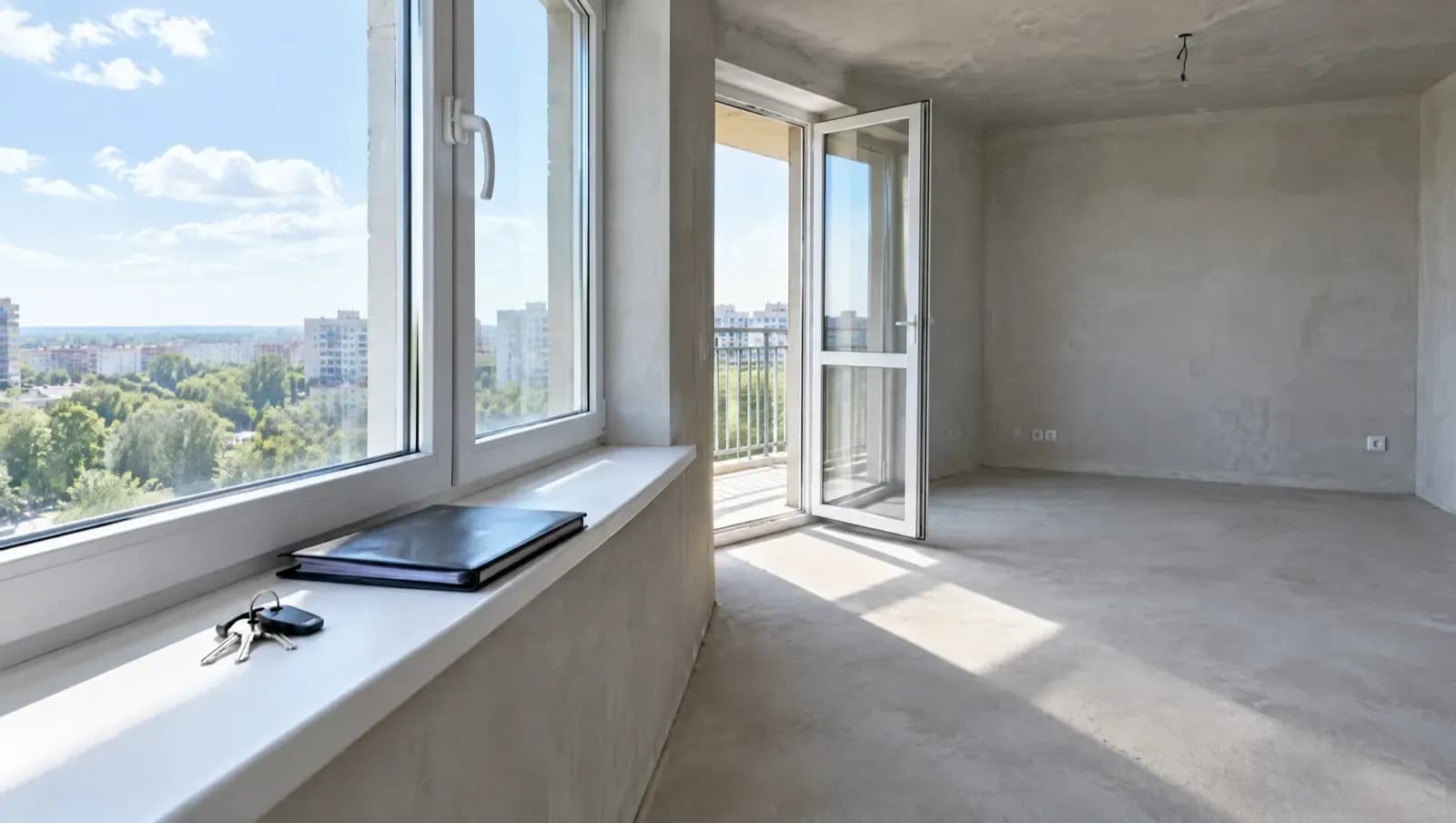
You've got the keys to your flat in developer standard (stan deweloperski) — what next? In the first few weeks, formalities matter most: the handover report and keeping track of deadlines for fixing defects, the notarial deed transferring ownership, meters and supplier contracts, the owners' association, the IN-1 property notice at the city office, and insurance. In parallel, you start measurements, a design and orders for the finish. Below is a checklist for the first 30–90 days with a table of deadlines.
Key facts
- For defects entered in the handover report, the developer responds within 14 days, and fixes acknowledged defects within 30 days of the report being signed.
- You file the property notice (IN-1) at the city office within 14 days of acquiring the flat. The property tax rate for a unit in Warsaw and Wrocław in 2026 is 1,25 zł/m² a year.
- Advances for the costs of managing the common property are paid in advance, by the 10th of each month.
- You have until the 30th day after moving in to register your address (zameldowanie).
- Under the statutory warranty (rękojmia), the developer is liable for physical defects found within 5 years of the unit being handed over.
What comes after the handover of a flat? A checklist with deadlines
The order of steps depends on your developer agreement (keys at the handover or after the deed), but the deadlines follow from the law. Here's what to sort out in the first weeks:
| What | Deadline | Where | Document |
|---|---|---|---|
| Handover inspection and listing defects | the deadline in the developer agreement | in the flat, with the developer's representative | handover report |
| The developer's response to reported defects | 14 days from signing the report | on paper or another durable medium | notice acknowledging the defects, or a refusal with reasons |
| Fixing acknowledged defects | 30 days from signing the report | in the flat | confirmation the defects have been fixed |
| The transfer-of-ownership agreement | the deadline in the developer agreement | the notary's office | notarial deed, applications to the land and mortgage register |
| Meter readings, an electricity (and gas) contract | at the handover, before moving in | your chosen energy supplier | a report with the readings, a document confirming your right to the unit |
| Advances to the owners' association | every month, by the 10th | the building's management board or manager | notice of the advance amount and the account number |
| The IN-1 notice (property tax) | 14 days from acquisition | the city or municipal office | the IN-1 form, details from the notarial deed |
| Registering your address (zameldowanie) | by the 30th day after arriving | the municipal office or online | the registration form |
| Insuring the flat | before moving in; with a mortgage — as required by the bank agreement | your chosen insurer | the policy (with a mortgage, often assigned to the bank) |
| Reporting a defect under the warranty | a defect found within 5 years of the unit being handed over | the developer | a written report with a description and photos |
The handover inspection and the defects report — keep track of the developer's deadlines
The handover inspection takes place once the occupancy permit for the building becomes final, in your presence (or your representative's), and it precedes the transfer of ownership (art. 41(1)–(2) of the developer act). Enter every defect in the report — only then do the statutory deadlines start running. We describe in detail how to prepare for the handover and what to check in the article Handover of a flat from a developer — checklist and report.
After the handover, keeping track of the calendar matters most. The developer has 14 days to tell you whether the defects are acknowledged, or to refuse with reasons; if they say nothing, the defects are treated as acknowledged (art. 41(4)–(5)). They fix acknowledged defects within 30 days of the report being signed (art. 41(6)). A defect you notice after the handover but before the deed can also be reported — in that case the deadlines run from the day it's reported (art. 41(19)).
Example: the calendar after a handover on 5 November
- 5 November — the handover, and the report is signed with 12 defects.
- 19 November — the developer's last day to respond (14 days). No response = the defects are acknowledged.
- 5 December — the last day to fix the acknowledged defects (30 days). If the developer can't make it despite due diligence, they must set a new deadline with reasons (art. 41(7)).
- until 5 November 2031 — you can report defects under the warranty (5 years from the unit being handed over).
Before the crew starts work, photograph the defects — once the tiles are down, it's harder to prove the condition before the finish.
Getting the keys vs. the notarial deed — when do you become the owner?
The handover itself doesn't make you the owner. Ownership only passes under the transfer agreement, concluded as a notarial deed, and its deadline has to be set out in the developer agreement (art. 35(1)(7) of the developer act). With a mortgage, agree the payout date for the final tranche with the bank. We break down the cost of the deed and the land and mortgage register entries in the article Costs of buying a flat from a developer.
Don't put off the handover or the deed without a reason. The law lets the developer withdraw from the agreement if the buyer doesn't show up for the handover or for signing the deed despite two written summons at least 60 days apart (art. 43(8)). If you can't be there in person, a representative is enough.
Meters in a new flat and supplier contracts
At the handover, record the readings of every meter (electricity, water, heat, gas — if there is one) in the report and photograph them. From this point on, you're usually the one who pays for what's used.
- Electricity — you sign a contract with an energy supplier in your own name. Ask the developer whether the meter is already fitted and what documents you'll need (usually the handover report or the deed, plus the supply point number). The renovation crew will need electricity too.
- Gas — if the building has a gas installation, the contract works the same way as for electricity.
- Water and heat — in blocks of flats, these are most often settled by the manager as part of the owners' association charges, based on sub-meters.
The owners' association in a new building, and advances
The owners' association is formed by all the owners of units in the property (art. 6 of the act on the ownership of premises) — you don't have to set it up yourself. In practice it arises once the developer separates out and sells the first unit. Until all the flats are sold, the developer is a member of it: for the unsold units, they have the same rights and duties as the other owners (art. 4(1)).
Developers often already entrust the management of the common property to a named company in the very first notarial deed. This management arrangement is also binding on later buyers (art. 18(1)–(2)), and can only be changed by a resolution of the owners recorded by a notary (art. 18(2a)). If no management arrangement has been set and there are more than three units, the owners must elect a management board by resolution (art. 20(1)).
You pay advances for management costs (including repairs, cleaning, insurance, the manager's fee) in advance, by the 10th of each month (art. 14–15). The association's settlement period is the calendar year (art. 29(1a)). After the deed, ask the manager for the account number and the amount of the advance.
Still looking for a flat and don't want to wait years for the handover? We'll help you find a flat in a building already in use — also with a finishing package, if the developer offers one. Usually no commission for the buyer, as the developer normally pays our fee.
Formalities after the handover of a flat from a developer: IN-1, registration, insurance
IN-1 and property tax
After acquiring the flat, you file a property notice with the city or municipal office on the IN-1 form — within 14 days of the circumstances giving rise to the tax obligation, i.e. for a purchase, from the day of acquisition (art. 6(6) of the act on local taxes and charges). The tax obligation arises from the first day of the month following the month of acquisition (art. 6(1)), and the tax for a given year is calculated in proportion to the number of months. The office sets the amount of tax by decision; it's paid in instalments by 15 March, 15 May, 15 September and 15 November.
A worked example. A 50 m² flat in Warsaw or Wrocław, with a land share corresponding to 30 m² of the plot. At the 2026 rates (1,25 zł/m² for the unit, 0,77 zł/m² for "other" land), the annual tax is 50 × 1,25 zł + 30 × 0,77 zł = 62,50 zł + 23,10 zł = 85,60 zł. If you sign the deed in October, the obligation starts on 1 November, so for 2026 you'd pay 2/12 of that amount, i.e. about 14,27 zł. You'll find the rates and calculation details in the article Property Tax on a Flat in Poland 2026.
What about the tax office? When you buy from a developer, the sale is subject to VAT, so you don't pay PCC and don't file a PCC-3 return. We explain when a visit to the tax office might be needed in the article Do you have to report buying a flat to the tax office?
Registering your address (zameldowanie)
After moving in, you're required to register your address no later than the 30th day after arriving at the new place (art. 27(1) of the population register act). You can do this at the municipal office or electronically, with a trusted, qualified or personal signature (art. 28(1)).
Insuring the flat
The building as a whole is usually insured by the owners' association (the cost is included in the advances). The unit, its contents and liability towards neighbours are a separate policy. With a mortgage, the bank usually requires flat insurance assigned to the bank. Update the sum insured once the finish is done.
Stan deweloperski — what's next for the finish? Measurements, design, orders
While the formalities are under way, you can plan the work. We describe exactly what stan deweloperski is and what it's missing in the article Stan deweloperski — what it includes. You'll find the full work schedule in the guide Finishing a developer's flat step by step. Three steps matter most to start with:
- On-site measurements. The floor plan from the prospectus is a design, not the actual state. Measure the walls, alcoves, and the height and position of the plumbing and socket points — the kitchen, bathroom and built-ins depend on these.
- Design and budget. Sketch out the furniture layout, lighting and electrical points before the crew starts chasing walls. Build the budget item by item — a flat finishing cost estimate with a buffer for the unexpected will help.
- Long-lead-time orders. A made-to-measure kitchen, interior doors and fitted wardrobes have lead times counted in weeks — check them before ordering and line them up with the crew's schedule.
If you're still waiting for the handover, check whether the developer accepts tenant fit-out changes — moving sockets or plumbing points at the construction stage is often simpler than chasing walls in a finished unit.
Reporting defects during the warranty period
After ownership is transferred, for anything not covered by art. 41 of the developer act, the Civil Code's provisions on the statutory warranty (rękojmia) apply to the developer's liability for defects (art. 41a). For real property, the warranty covers physical defects found before five years have passed from the day the unit was handed over (art. 568 §1 of the Civil Code). A claim to have a defect fixed lapses a year after it's found, but for a consumer, not before those five years are up (art. 568 §2).
Report defects in writing, with a date, a description and photos, and keep copies. After the first heating season, check the radiators, ventilation and any cracks — some defects only show up after a few months.
Flats ready to move into — in our offer
If you're still choosing a flat, buying in a building already in use shortens the road to the keys. According to TM Invest's offer, as of 27.09.2026, 1101 flats are available in completed developments: 673 in Warsaw and 428 in Wrocław.
| City | Completed developments | Available flats | Median price | Median price per m² | Handover in the fourth quarter of 2026 |
|---|---|---|---|---|---|
| Warsaw | 37 | 673 | 831k zł | 16 208 zł | 15 developments, 429 flats |
| Wrocław | 24 | 428 | 815k zł | 14 640 zł | 4 developments, 210 flats |
In completed buildings, the median price of a 2-room flat is about 727k zł in Warsaw and 699k zł in Wrocław. Browse offers on the pages new homes in Warsaw and new homes in Wrocław, or in the catalogue of all developments.
Read also:
Frequently asked questions
What comes first: the handover of the flat or the notarial deed?
The handover comes first. The developer act provides that the transfer of ownership is preceded by the buyer's handover inspection of the unit, carried out once the occupancy permit becomes final. You sign the notarial deed by the deadline stated in the developer agreement.
How long does the developer have to fix the defects from the report?
They have 14 days to respond from the report being signed, and 30 days to fix acknowledged defects. No response within 14 days means the defects are treated as acknowledged.
From when do you pay the owners' association charge in a new building?
The point at which payments start is usually set by the developer agreement — most often it's the day the unit is handed over or ownership is transferred. Advances are paid in advance, by the 10th of the month.
When do you file the IN-1 after buying a flat from a developer?
Within 14 days of acquiring the flat, i.e. from the day of the notarial deed transferring ownership. You file the form at the city or municipal office covering the area where the flat is, either on paper or electronically.
Can you start finishing before the notarial deed?
It depends on the developer — until the deed, they remain the owner. Some developers hand over the keys after the handover inspection and allow work to start, others only after the deed. If you get permission, ask for it in writing, and document the unit's condition with photos before work begins.
Do you have to go to the tax office after buying a flat from a developer?
As a rule, no. A sale by a developer is subject to VAT, so you don't pay PCC and don't file a PCC-3. The IN-1 notice at the city or municipal office is, however, mandatory.
Summary
The first weeks after the handover are about deadlines: 14 and 30 days for the developer over defects, the deed as set out in the agreement, the IN-1 within 14 days of acquisition, advances by the 10th of the month and registering your address within 30 days. Note them in your calendar, keep the report and photos, and in parallel do the measurements, the design and the long-lead-time orders — that way the finishing work can start without delays.
Planning a purchase and want the keys sooner? We'll find you a flat from a developer — also ready to move into or with a finishing package, and guide you through the reservation, the agreement and the handover. Usually no commission for the buyer, as the developer normally pays our fee. On the market since 2016.
Legal status as of September 2026. The worked examples are illustrative; this article is not legal or tax advice.
Sources
- Act on the protection of the rights of buyers of a residential unit or single-family house and the Developer Guarantee Fund — consolidated text Dz.U. 2026 item 880 (art. 35(1)(7), art. 41, art. 41a, art. 43(8)).
- Act on the ownership of premises — consolidated text Dz.U. 2026 item 232 (art. 4, 6, 14, 15, 18, 20, 29).
- Act on local taxes and charges — consolidated text Dz.U. 2025 item 707 (art. 6).
- Notice of the Minister of Finance and the Economy on the upper limits of local tax and charge rates for 2026 — M.P. 2025 item 726; the 2026 rates: resolution no. XXIX/1066/2025 of the Warsaw City Council (Dz. Urz. Woj. Maz. 2025 item 9838) and resolution no. XXV/500/25 of the Wrocław City Council (Dz. Urz. Woj. Doln. 2025 item 4981).
- Pay your property tax — gov.pl (the IN-1 notice).
- Population register act — consolidated text Dz.U. 2026 item 384 (art. 27–28).
- Civil Code — consolidated text Dz.U. 2026 item 795 (art. 568).
- Flat prices: TM Invest's catalogue of new homes, as of 27.09.2026.