











Layout changes with the developer – what to change, cost, deadline
 Author: Tacjana MasiukiewiczFinishing and fitting out~14 min read
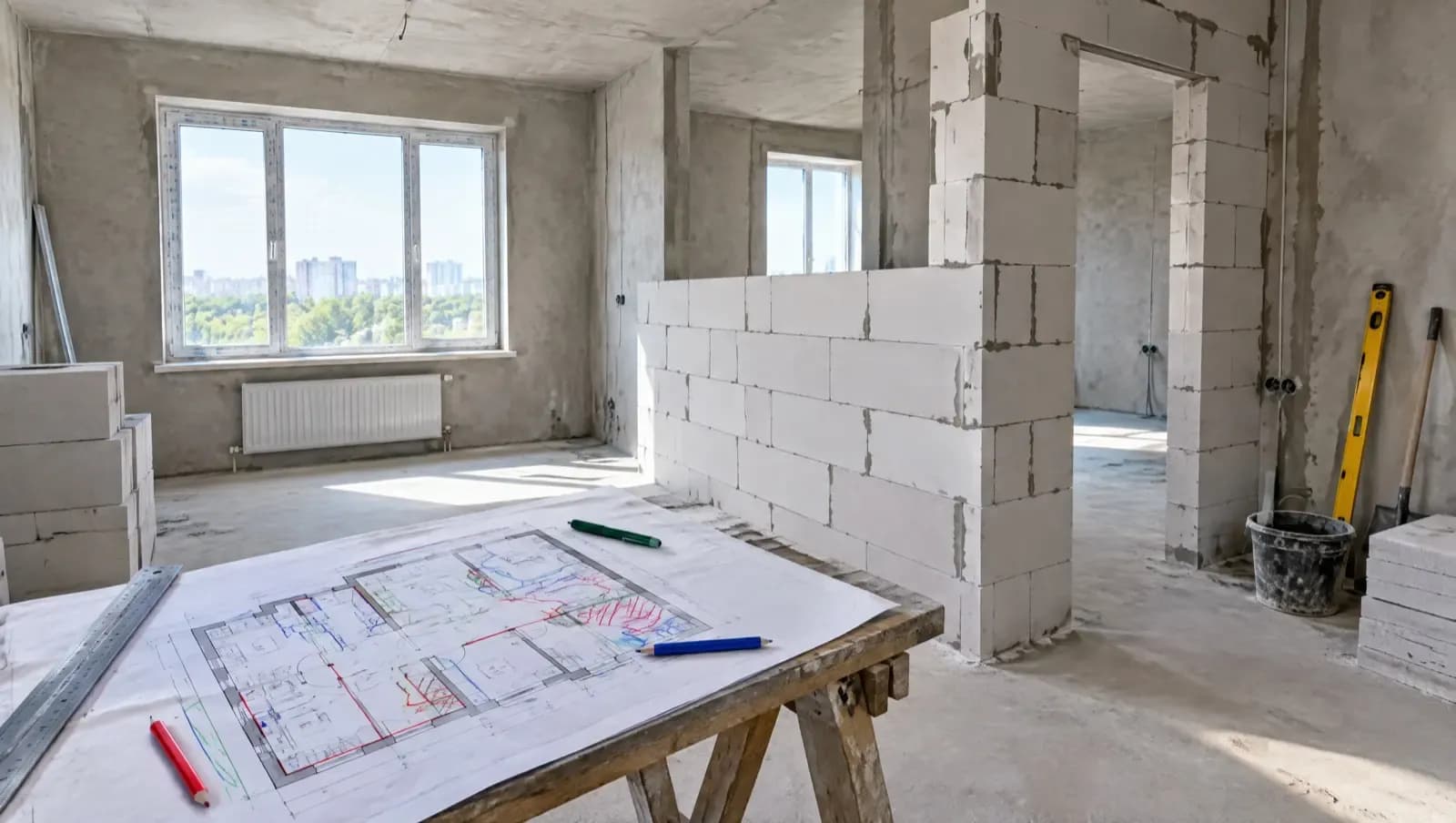
Layout changes (in Polish zmiany lokatorskie) are alterations to a flat's layout that the developer carries out at your request while the building is still under construction — most often moving partition walls, sockets, light points or the water and drain connections in the kitchen and bathroom. The structure, service risers, façade and windows usually cannot be changed. Below we explain what the procedure looks like, what it costs using examples from developers' published regulations, by when you must submit changes and how they affect price, handover and warranty liability.
Key points
- The Developer Act does not regulate layout changes directly — the rules, deadlines and price list follow from the developer contract (umowa deweloperska) and the developer's regulations.
- Deadlines can be short: for example Novisa Development requires submission within 14 days of signing the developer contract; Dekpol — before the date given in the contract.
- Example fees from Novisa's price list: an application PLN 100 (each further variant PLN 490), a coordination fee of PLN 648 and replacement documentation of PLN 648 gross — plus the cost of the works themselves.
- In contracts concluded from 13 February 2026 the price is the product of the usable area and the price per 1 m² (Art. 5a of the Developer Act) — so a change in size after alterations carries over into the price.
- In our offer 36 of 73 projects in Warsaw and 21 of 45 in Wrocław are under construction — only there are layout changes possible at all.
What can you change with a developer, and what not?
The scope is set by the developer, but the regulations are similar. Dekpol allows, among other things, moving or removing partition walls, changing the position of interior doors, sockets and light points, kitchen and bathroom connections and radiators. It excludes the building's structure, risers (water and drainage, heating, ventilation) and the façade, including windows and balcony doors. YIT adds to the prohibitions, among others, common areas and the entrance door.
| Change | Usually possible? | Until when | Notes |
|---|---|---|---|
| Moving or removing a partition wall | Yes | Before the partitions are built | May change the usable area and the price |
| An additional partition (e.g. a dressing room, a second bedroom) | Yes, if technical regulations allow | As above | A new room needs a window and ventilation consistent with the design |
| Moving interior doors | Yes | Before the partitions are built | Check for clashes with installations |
| Sockets, switches, light points, TV/LAN sockets | Yes | Before plastering | The most common and usually the cheapest change |
| Water and drain connections (kitchen, bathroom) | Yes, within reach of the riser | Before screeds and plastering | A drain needs a fall — it cannot be moved far from the riser |
| Radiators (position, number) | Often yes | Before the heating installation is done | With underfloor heating usually harder |
| Dropping part of the works (e.g. partitions, sanitary installation in a package) | Depends on the developer | As for the given trade | Does not always reduce the price — ask about the settlement |
| Risers, load-bearing walls, floors | No | – | The building's structure and shared installations |
| Windows, balcony doors, balcony, façade | No | – | They follow from the building permit |
| Entrance door, common areas | No | – | Outside the unit's boundaries |
The developer may refuse, for example when a change is excessive interference with advanced works (Dekpol reserves this). Planning bathroom alterations? See the article A bathroom in a new flat – how much finishing costs — the bath, shower or position of the WC are worth fixing already at the layout-change stage.
How to submit layout changes – the procedure step by step
The scheme is similar at most developers:
- The developer contract. Applications are usually accepted only after it is signed (e.g. at Dekpol) — ask about the regulations and the deadline already when you reserve.
- An application with a drawing. On the unit's floor plan (a trade sheet) you mark what to remove and what to add, with dimensions. Dekpol requires elements to be removed to be marked with a red "X" and new ones in green.
- Verification and the designer's opinion. The developer, contractor and architect check feasibility and compliance with regulations.
- A quotation. It usually includes replacement documentation (a design of the changes), works and materials, and sometimes a coordination fee. At Dekpol you have 5 working days to accept the quotation.
- Signing the document and payment. This may be an order, a layout-change card with a cost protocol or an annex to the contract. The developer starts work after payment — at Novisa within 5 days of signing, at Dekpol on the basis of an invoice.
- Execution and handover. The changes are carried out by the developer during construction; Dekpol states that the date of their completion coincides with the unit handover date from the contract.
Layout changes and the developer contract – an annex or a separate order?
The developer contract must specify, among other things, the usable area of the unit, the area and layout of the rooms and the scope and standard of finishing works (Art. 35(1)(6) of the Developer Act), and it is concluded in the form of a notarial deed (Art. 40(1)). The Civil Code in turn provides that an amendment to a contract requires the form prescribed for its conclusion (Art. 77 § 1). The Developer Act, however, does not directly settle how to document layout changes, so in practice you will meet two solutions: a separate order or contract for the changes (e.g. an "order for layout works" at Dekpol, a "layout-change card" at Novisa) or an annex to the developer contract in the form of a notarial deed.
It is important that the document describes the scope, the price and the payment date, the effect on the size and price of the unit, and the consequences of the changes not being carried out. Watch for provisions on non-payment — Dekpol may then hand over the unit without the changes. The general rules for reading a contract are described in the article The developer agreement – what it must contain.
Not sure whether the developer's document protects you? We will review the developer contract and the annex or order for layout changes — we will point out provisions on price, size and deadlines that are worth clarifying before you sign.
Layout changes – cost, using examples from developers' price lists
There is no single market price list — the cost depends on the developer, the scope and the construction stage. Here is what developers publish on their websites:
| Developer | Submission deadline | Fixed fees | Cost of works |
|---|---|---|---|
| Novisa Development | 14 days from signing the developer contract | Application: PLN 100 (each further variant PLN 490); for referring changes in a given trade a coordination fee of PLN 648 + replacement documentation PLN 648 (gross); suspending work in the unit for 14 working days — PLN 2,490 | Quoted individually; demolition of works already done — extra |
| Dekpol | Before the date given in the developer contract | Estimated costs in an annex to the regulations | General contractor's quotation: replacement documentation + works and materials, payable by invoice before work starts |
| YIT | The deadline is set individually for each construction | The developer declares that it charges no fee for its service | You pay for the changes, the architects' work and possibly the general contractor |
A worked example. You buy a 2-room flat of 40.8 m² at PLN 16,000/m² — the medians for such flats in Wrocław according to the TM Invest offer as of 27 September 2026 (a price of about PLN 652.8k). You want to separate a dressing room with a new partition and move a few sockets. With a price list like Novisa's, the fixed fees alone for one trade (architectural and construction) come to PLN 100 + 648 + 648 = PLN 1,396, and for electrics as a second trade another coordination fee is added. On top comes the cost of the works according to the quotation. If a new partition 3 m long and about 10 cm thick reduces the usable area by about 0.3 m², and the contract provides for settlement by actual size, the unit price will fall by 0.3 × 16,000 = PLN 4,800. Whether and how this happens depends on the contract provisions, so ask about it before signing the order.
By when to submit layout changes? Data from our offer
The deadline is set by the contract or the regulations, and in practice by the progress of construction: when the partitions stand and the installations are plastered, a change means demolition. The most freedom is given by projects with a distant completion date. According to the TM Invest offer as of 27 September 2026:
| Project stage | Warsaw: projects / available flats | Wrocław: projects / available flats | Chance of layout changes |
|---|---|---|---|
| Completed (put into use) | 37 / 673 | 24 / 428 | None — alterations are after handover, at your own cost |
| Under construction, completion in Q4 2026 (including first stages) | 16 / 430 | 6 / 368 | Small — work is usually well advanced |
| Under construction, completion in 2027 | 17 / 865 | 7 / 337 | Depends on the stage — check the deadline in the contract |
| Under construction, completion in 2028 and later | 3 / 269 | 8 / 981 | The greatest |
Examples with a distant completion date are, in Wrocław, among others Altera in Stare Miasto (Dekpol, Q1 2028) — the same developer whose regulations we cite above — and in Warsaw Premiera Bemowo (Q1 2028). You will find the full list in the catalogues of new flats in Warsaw and new flats in Wrocław. An alternative without a change procedure is a finishing package from the developer.
Change in size and price after layout changes
From 13 February 2026, in developer and reservation contracts the unit price is defined as the product of the usable area and the price per 1 m², and the area is calculated according to the Polish Standard in force on the day the building permit application was filed (Art. 5a of the Developer Act, added by the Act of 4 December 2025). The new rules apply to contracts concluded from that day. The provision does not say how to settle the difference between the size in the contract and the measurement — the contract does that. Moving walls can change the size, so:
- ask for the change document to state the expected area after the alterations,
- check in the developer contract the rules for settling area differences and the method of measurement (Art. 35(1)(15)),
- establish whether you pay for the changes separately (by invoice) or whether they change the price in the developer contract.
Layout changes and a mortgage
The bank finances the price from the developer contract and pays out tranches according to the schedule. In the procedures described, layout changes are paid for separately, before work starts — so usually from your own funds. If an annex changes the price or area of the unit, give it to the bank before the next tranche; requirements depend on the loan agreement. How a loan is paid out in tranches is described in the guide Mortgage in Poland step by step.
Layout changes, handover, statutory warranty and guarantee
Changes made by the developer are part of the unit you take over. At handover compare the condition with the card or design of the changes and enter discrepancies in the protocol — the developer has 14 days to accept defects or refuse with reasons and 30 days to remedy accepted defects (Art. 41(4) and (6) of the Developer Act). You will find a checklist in the article Flat handover from a developer.
After ownership is transferred, the Civil Code provisions on rękojmia (the seller's statutory warranty) on sale apply to the developer's liability for defects (Art. 41a of the Developer Act). For real estate the seller is liable if a defect is established within five years of delivery (Art. 568 § 1 of the Civil Code), but only for defects that existed at the time of delivery or arise from a cause then present in the unit (Art. 559). The developer is therefore responsible for a partition built by the developer, and your contractor for one built after handover by your crew. The developer's guarantee works according to its guarantee statement — check that it does not exclude elements altered after handover. The next steps after collecting the keys are described in the guide Finishing a developer-standard flat step by step.
Frequently asked questions
Are layout changes paid?
Yes, you almost always pay at least for the design of the changes (replacement documentation) and the works. Some developers also charge fixed fees — e.g. Novisa: PLN 100 for an application and PLN 648 gross each for the coordination fee and for replacement documentation in a given trade. YIT declares that it charges no fee for its service, but the buyer bears the costs of the design and the works.
By when can layout changes be submitted?
By the date given in the developer contract or the regulations — sometimes even 14 days from signing the contract. Even without a rigid deadline, a change becomes impossible or more expensive once the given trade (partitions, electrics, water and drainage) has been done.
Can a partition wall be moved in a flat from a developer?
Usually yes, if it is a partition and not a load-bearing wall and the new layout meets technical regulations (e.g. access to a window in a room, ventilation). This requires the developer's consent, the designer's opinion and replacement documentation. Remember that moving a wall can change the usable area, and so the price.
Do layout changes require a notarial annex?
The Developer Act does not settle this directly. The developer contract is in the form of a notarial deed, and amending it requires the same form (Art. 77 § 1 of the Civil Code), so when the price or area from the contract changes, developers often draw up an annex at a notary. The works themselves are sometimes ordered by a separate document — check how your developer does it.
Do layout changes affect the statutory warranty?
Changes made by the developer before the unit is handed over are covered by the warranty like the rest of the flat — for real estate, five years from delivery. Alterations made after handover by your own crew do not burden the developer, and defects arising from this work will be hard to attribute to it.
Can layout changes be made in a ready flat?
No — in a building already put into use you do the alterations yourself, after handover and at your own risk. If changes matter to you, look among projects under construction: in our offer that is 36 projects in Warsaw and 21 in Wrocław (as of 27 September 2026).
Summary
Layout changes let you adapt the arrangement of walls and installations without chiselling after handover, and the developer is responsible for the work done. Submit them quickly — deadlines are sometimes counted in days from the contract, and costs rise as construction progresses. Before signing, check the scope, price, effect on size and payment dates.
Looking for a flat under construction where you can still make changes? We will help you choose a flat from a developer — most often without a commission for the buyer, the fee is usually paid by the developer. And when you get a contract, annex or order for changes to sign, we will review the documents before you sign.
Legal status as of September 2026. Developers' fees and deadlines come from their publicly available regulations and websites and may differ between projects. The calculations are indicative. The article is not legal advice.
Sources
- Act of 20 May 2021 on the protection of the rights of a purchaser of a dwelling or single-family house and on the Developer Guarantee Fund, consolidated text Dz.U. 2026 item 880 (in Polish) – Art. 5a, 35, 40, 41, 41a
- Act of 4 December 2025 amending the act on the protection of the rights of a purchaser… (Dz.U. 2026 item 27) (in Polish) – Art. 5a and the transitional provision
- Civil Code, consolidated text Dz.U. 2026 item 795 (in Polish) – Art. 77, 559, 568
- Dekpol – Regulations for introducing layout changes (in Polish)
- Novisa Development – layout changes: procedure and fees (in Polish)
- YIT – layout changes with the developer step by step (in Polish)
- Flat prices and construction stages: TM Invest project catalogue, as of 27 September 2026