











Laminate or Real Wood? Vinyl and Porcelain Tiles – Flooring Cost in a Flat 2026
 Author: Tacjana MasiukiewiczFinishing and fitting out~14 min read
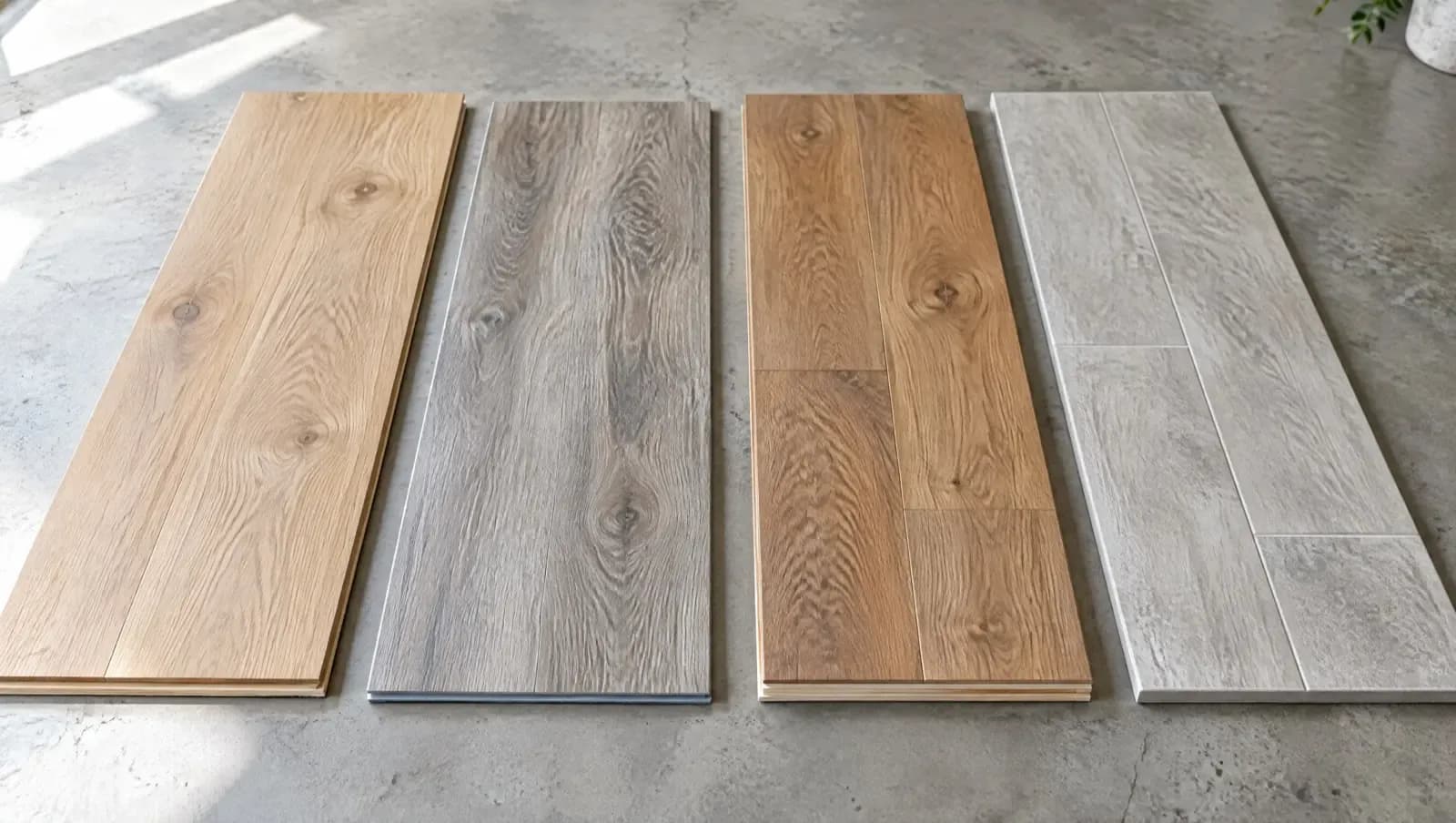
Laminate or wood? For a typical new flat the cheapest solution is laminate flooring (about PLN 5.4k for the floor of a 2-room flat), SPC vinyl costs about 30% more but copes better with water, and engineered wood is twice as expensive as laminate, but gives you natural timber and the option of renovation. Below we compare five types of flooring – material and fitting prices from September 2026 price lists, water resistance, noise and underfloor heating – and we calculate four options for a 40 m² flat.
Key facts
- Indicatively (September 2026): AC4 laminate about PLN 25–48/m², SPC vinyl about PLN 50–160/m², engineered oak about PLN 70–310/m², wood-effect porcelain tiles 20 × 120 cm about PLN 60–120/m².
- Fitting: click laminate PLN 35–65/m², click vinyl PLN 40–70/m², engineered wood floating PLN 55–100/m² and glued PLN 80–150/m²; porcelain tiles laid in a staggered pattern – PLN 140–240/m².
- Our calculation for 35 m² of floor (2-room flat without the bathroom): from about PLN 5.4k (laminate) to about PLN 12.6k (wood-effect porcelain tiles) – with skirting boards and a waste allowance.
- For underfloor heating the thermal resistance of the whole covering (floor + underlay) should not exceed 0.15 m²K/W, and the surface temperature – 27°C (manufacturers' recommendations).
- The screed must be dry: construction chemicals manufacturers usually give a maximum of 2% CM for a cement screed and 0.5% CM for an anhydrite one (without underfloor heating).
What flooring for a flat? A comparison of five solutions
In a new flat in developer standard (stan deweloperski) you lay the floor on a ready screed, so the choice comes down to budget, water resistance and how you want the floor to age. The table gathers indicative ranges from price lists of shops and finishing firms in Warsaw (September 2026) – material prices in shops are gross, while labour rates in firms' price lists often do not specify whether they are net or gross.
| Type of flooring | Material | Fitting | Water | Renovation | Underfloor heating |
|---|---|---|---|---|---|
| Laminate (AC4, class 32) | PLN 25–48/m² + underlay about PLN 7/m² | PLN 35–65/m² (Wroclaw 40–80) + underlay PLN 8–18/m² | HDF core absorbs water; some models have a declared resistance to standing water for a set time | none – replacement | yes, if the manufacturer permits |
| Click SPC vinyl | PLN 50–160/m² (most often 60–120) | PLN 40–70/m² (glued 55–100) | manufacturers declare the panels waterproof | none – replacement | yes, if the manufacturer permits |
| Engineered oak | about PLN 70/m² (promotions) – 140–310/m² | PLN 55–100/m² floating, 80–150/m² glued | sensitive to standing water | sanding of the wear layer | depends on the model and the method of installation |
| Solid parquet | depends on the species and grade of wood | from PLN 50–60/m² + sanding with lacquering 110–180/m² | sensitive to water | repeated sanding | requires the manufacturer's consent |
| Wood-effect porcelain tiles 20 × 120 cm | PLN 60–120/m² + adhesive, grout | PLN 140–240/m² (difficult formats 230–400) | resistant | practically none needed | conducts heat best |
If you are only just planning the layout and budget of the whole flat, start with the text How to furnish a 2-room flat – the floor is just one of the decisions worth making before the crew comes in.
Laminate flooring – AC classes and use classes
Laminate flooring is tested according to the EN 13329 standard (in Poland PN-EN 13329). Two parameters on the packaging tell you most about durability:
- AC abrasion class – the result of a test of the top layer's resistance to abrasion. Manufacturers state, for example, AC4 at a result of at least 4000 revolutions in the test and AC5 – at least 6000. The AC class is also linked to a required impact resistance.
- Use class – a two-digit number: the digit 2 means domestic use (21–23), the digit 3 – public use (31–33), and the second digit is the traffic intensity. On the packaging you will usually see "23/32" or "23/33".
In practice AC4 and class 32 are enough for a flat – such laminate at about PLN 25–48/m² is standard in DIY stores. AC5 / class 33 makes sense in the hallway and with a large dog, but the price difference for the whole floor of 35 m² is usually a few hundred zloty.
Vinyl or laminate panels?
SPC vinyl has a rigid mineral-polymer composite core instead of an HDF board, which is why manufacturers declare it waterproof – an argument for vinyl in a kitchen open to the living room and in the hallway. Laminate is cheaper and harder on the surface, but water seeping into the joints can make the board swell. Some laminate manufacturers state resistance to standing water for a set time (e.g. 24 hours) – check this in the technical data sheet, not in the collection name.
Noise: floating floors (laminate, click vinyl, floating engineered wood) are laid on an underlay, and its quality affects how the floor "sounds" in your flat and how it transmits the sound of footsteps. Underlay manufacturers state, among other things, thermal resistance and sound-damping parameters – compare them rather than choosing the cheapest foam. Vinyl usually already has an integrated underlay; do not add a second one without the manufacturer's consent.
Engineered wood and parquet – price and durability
Engineered wood (e.g. three-layer, 14 mm) has a solid wood top layer on a stable base of softwood or board. Prices of oak boards from well-known manufacturers start at about PLN 70/m² in DIY store promotions, typical models cost PLN 140–160/m², and wide single-strip boards – PLN 260–310/m². You lay it floating (PLN 55–100/m²) or glued to the screed (PLN 80–150/m²) – gluing is more expensive, but the floor is quieter and passes on the heat from underfloor heating better.
The biggest advantage of wood is the possibility of renovation: a scratched board with a sufficiently thick wear layer can be sanded and lacquered or oiled again, while laminate has to be replaced. Solid parquet is usually laid raw and only then sanded and lacquered – in the price lists of Warsaw parquet fitters laying is about PLN 50–60/m², and sanding with lacquering about PLN 110–180/m², plus the lacquer drying time. In a new flat, where the move-in date matters, a factory-finished engineered board is chosen more often.
Wood-effect porcelain tiles – when to choose tiles instead of laminate?
Porcelain stoneware imitating wood (most often 20 × 120 cm planks) is fully resistant to water, scratches and claws, and with underfloor heating it passes on heat best of all the solutions. The material is not expensive – about PLN 60–120/m² – but laying elongated tiles in a staggered pattern costs PLN 140–240/m², and for difficult formats even PLN 230–400/m². A tile is also cold to the touch without heating and hard – dropped objects break more often. A good compromise is porcelain tiles in the hallway and kitchen, and laminate or wood in the rooms.
How much does flooring cost in a 40 m² 2-room flat? A calculation
The median floor area of 2-room flats in our offer is 40.8 m² in Wroclaw and 39.4 m² in Warsaw (according to data from the TM Invest offer, as at 27.09.2026). We assume a 40 m² flat in which the bathroom (about 5 m²) gets tiles, and the floor of your choice covers 35 m² of rooms, kitchenette and hallway. Assumptions:
- waste allowance for cuts: 7% for laminate, vinyl and wood (purchase of 37.5 m²), 10% for porcelain tiles (38.5 m²),
- MDF skirting boards: 36 running metres to fit, purchase of 16 pieces of 2.4 m (38.4 running metres) at PLN 12 per running metre, installation PLN 35 per running metre – in total about PLN 1 721 in every option,
- unit prices from the middle of the ranges in the table above; chemicals for the tiles (flexible adhesive, grout, primer) – our assumption of about PLN 460.
| Item | AC4 laminate | Click SPC vinyl | Engineered oak (floating) | Wood-effect porcelain tiles 20 × 120 |
|---|---|---|---|---|
| Floor material | PLN 1 313 (37.5 m² × PLN 35) | PLN 3 375 (37.5 m² × PLN 90) | PLN 6 000 (37.5 m² × PLN 160) | PLN 3 465 (38.5 m² × PLN 90) |
| Underlay / chemicals | PLN 281 (PLN 7.5/m²) | integrated | PLN 281 (PLN 7.5/m²) | PLN 460 (assumed) |
| Floor labour | PLN 2 100 (35 m² × PLN 60 with underlay) | PLN 1 925 (35 m² × PLN 55) | PLN 2 975 (35 m² × PLN 85 with underlay) | PLN 7 000 (35 m² × PLN 200) |
| Skirting boards with installation | PLN 1 721 | PLN 1 721 | PLN 1 721 | PLN 1 721 |
| Total | approx. PLN 5 415 | approx. PLN 7 021 | approx. PLN 10 977 | approx. PLN 12 646 |
| Per m² of floor | approx. PLN 155 | approx. PLN 201 | approx. PLN 314 | approx. PLN 361 |
The difference between the cheapest and the most expensive option is about PLN 7.2k – for a 2-room flat at PLN 662k (the median in our offer in Wroclaw) that is about 1.1% of the price of the unit. You can also see that with porcelain tiles more than half of the cost is labour, and with wood – the material. You must add any levelling of the base (self-levelling compound PLN 30–60/m²), transition profiles and trimming of door frames (PLN 50–100 each). Two notes on the budget: according to GUS (Statistics Poland), prices of specialised construction works in August 2026 were 7.0% higher than a year earlier, so older quotes go out of date quickly. And if the floor with material bought by the contractor is laid by a firm in a unit of up to 150 m², the service may be subject to 8% VAT instead of 23% – details in the text 8% VAT on flat finishing. How to put these items together into a single budget we show in the article Flat finishing cost estimate, and the per-m² rates for the whole finishing – in the text How much does flat finishing cost.
Are you only just choosing the flat you will finish? We will help you find a unit from a developer in Warsaw or Wroclaw and go through the reservation, the agreement and the handover – help in buying a flat from a developer is for you in most cases without a commission, because the developer usually pays our fee.
Underfloor heating and laminate or wood
If the flat has water underfloor heating, every layer on the screed acts as insulation. Flooring manufacturers recommend that the total thermal resistance of the covering (floor + underlay) should not exceed 0.15 m²K/W, and the floor surface temperature – 27°C. The resistance of 8 mm laminate alone is, according to data sheets, about 0.07 m²K/W, so the result is decided mainly by the underlay – choose one that the manufacturer designates for underfloor heating and that has a low thermal resistance.
- Porcelain tiles – the best heat conduction, without the limitations typical of wood.
- Vinyl and laminate – good, if the manufacturer expressly permits underfloor heating (a symbol on the packaging) and you choose a thin underlay.
- Engineered wood – better glued than floating; wood reacts to changes in temperature and humidity, so the heating is switched on and off gradually.
Screed in developer standard – when can you lay the floor?
A new screed gives off moisture for many weeks, and one that is too damp is the most common cause of warped boards and adhesive coming away. Construction chemicals manufacturers state that before laying the floor the moisture of the base measured by the carbide method (CM) should be at most 2% for a cement screed and 0.5% for an anhydrite one – for a base without underfloor heating. With heating the requirements are stricter: one flooring manufacturer gives, for example, 1.5% CM for cement and 0.3% CM for anhydrite. The values in the installation instructions for your floor always apply.
What to do in practice: ask the crew to measure the moisture (an electronic meter gives a preliminary assessment, a CM measurement – a binding result), check the flatness of the screed with a straightedge, and under a floating floor on a mineral base lay a vapour barrier film if the underlay does not have one (installation about PLN 6–15/m²). With underfloor heating the screed should go through a heat-up procedure according to the installer's procedure – ask the developer whether it has been done. The order of finishing works is described in the guide Finishing a developer-standard flat step by step.
Frequently asked questions
Laminate or wood – which is better for a flat?
Laminate is about twice as cheap (in our calculation PLN 5.4k versus PLN 11k for 35 m²) and scratch-resistant, but once damaged it has to be replaced. Engineered wood is more expensive, warmer to the touch and can be renovated by sanding. For a rental flat laminate or vinyl is usually chosen, for a flat "for years" – more often wood.
How much does laying laminate cost per m² in 2026?
In the price lists of Warsaw firms, laying click laminate in a simple pattern costs about PLN 35–65/m², in Wroclaw about PLN 40–80/m². Installing the underlay is an additional PLN 8–18/m², and MDF skirting boards – PLN 25–45 per running metre. Herringbone is clearly more expensive: PLN 70–110/m² for laminate and PLN 90–140/m² for vinyl.
Is vinyl flooring suitable for the kitchen and hallway?
Yes, that is its main advantage over laminate – SPC vinyl manufacturers declare the panels waterproof. Water should not, however, stay by the walls and under the skirting boards, and with glued vinyl the base must be very even, because any unevenness will show through the thin layer.
What laminate for underfloor heating?
One for which the manufacturer expressly permits underfloor heating, laid on an underlay with a low thermal resistance. The total resistance of the covering should not exceed 0.15 m²K/W, and the surface temperature – 27°C. Porcelain tiles conduct heat best, and glued engineered wood and vinyl also work well.
How much spare laminate should you buy?
With a simple layout in a typical flat about 5–10% is assumed for cuts – in our calculation 7%, i.e. 37.5 m² for 35 m² of floor. With herringbone and many alcoves the allowance grows. Buy the material from one batch and keep one pack for possible repairs.
Summary
AC4 laminate is the cheapest and fully sufficient floor for most flats. SPC vinyl costs about PLN 1.6k more for 35 m², but copes better with water, engineered wood gives you timber and the option of renovation, and wood-effect porcelain tiles – maximum resistance and the best compatibility with underfloor heating, at the price of the most expensive labour. Whichever you choose, check the moisture of the screed and the manufacturer's approvals. If you are finishing a unit to let, also look at the text Finishing a flat for rent, and you will find offers of completed and under-construction developments in the catalogues new flats in Warsaw and new flats in Wroclaw.
Looking for a flat where you will plan the finishing from the start? Since 2016 our experts have been helping buyers on the primary market in Warsaw and Wroclaw – use our help in buying a flat from a developer, in most cases without a commission for you (the developer usually pays our fee).
Legal position as at September 2026. Material and labour prices are indicative (price lists of shops and firms, September 2026) and depend on the specific product, the condition of the base and the contractor. Always check technical parameters (base moisture, thermal resistance, temperature) in the installation instructions for the floor you choose. The article is not technical or tax advice.
Sources
- Value Added Tax Act (consolidated text Dz.U. 2025 item 775), art. 41(12)–(12c) – 8% VAT on services in residential units of up to 150 m²
- GUS – Price indices of construction and assembly output in August 2026
- Technical data sheet of laminate flooring – AC and use classes according to EN 13329, thermal resistance according to EN 12667
- Technical guide of a construction chemicals manufacturer – base moisture by the CM method
- Flooring manufacturer's instructions on installation over underfloor heating – thermal resistance up to 0.15 m²K/W, surface temperature up to 27°C, screed moisture with heating
- Material and labour prices: price lists of DIY stores, flooring shops, finishing firms and parquet fitters in Warsaw and Wroclaw, September 2026 (indicative)
- Flat prices: TM Invest development catalogue, as at 27.09.2026