











Short-Term Rental in Poland 2026 – Rules, Register, Taxes, Owners' Association
 Author: Tacjana MasiukiewiczInvesting~16 min read
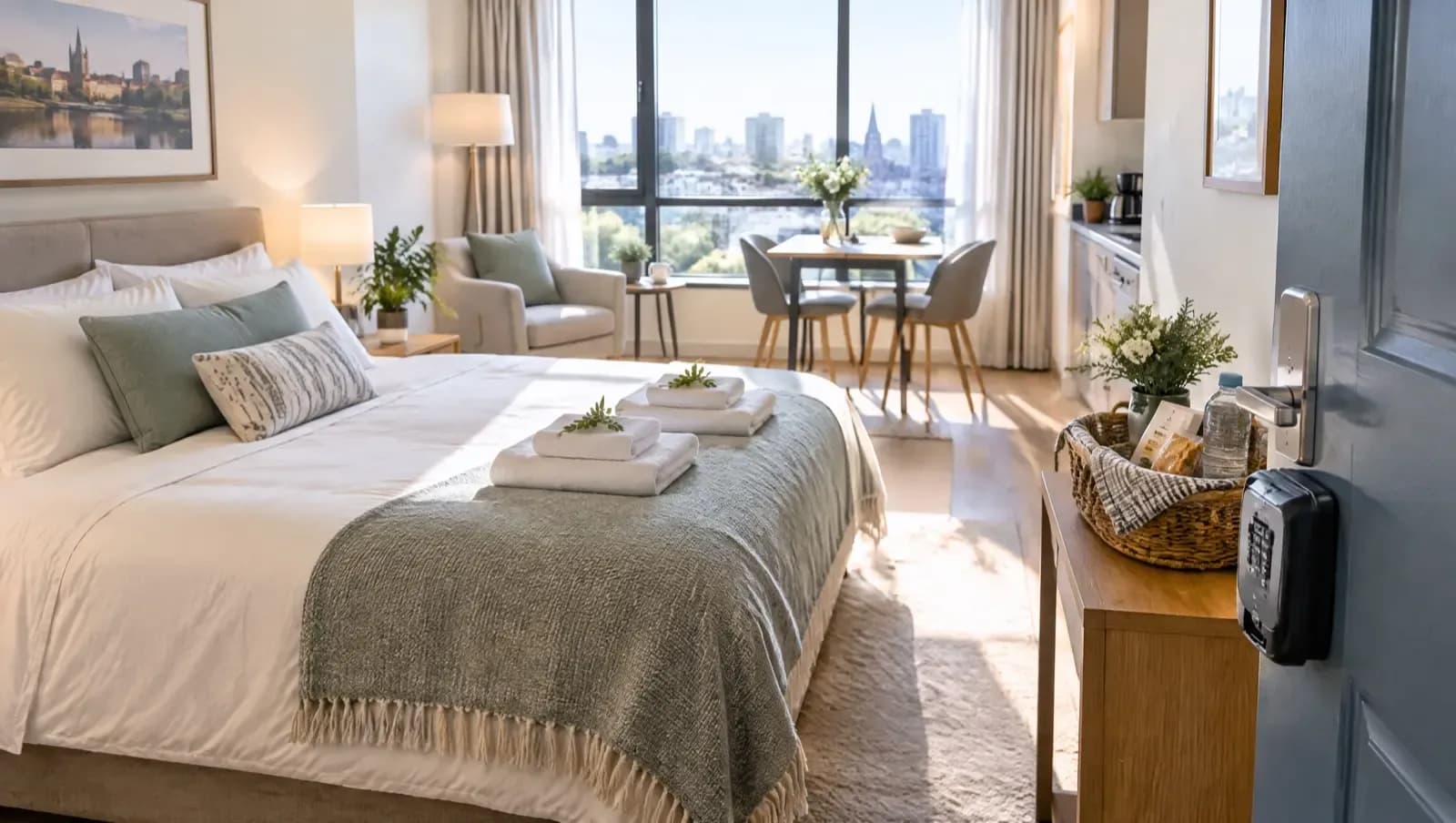
Short-term rental in 2026 is governed today by three layers of rules: EU Regulation 2024/1028, which applies from 20 May 2026, the current Act on Hotel Services with the obligation to report a unit to the municipal register, and tax rules (flat-rate tax, VAT, resort fee). The Polish implementing act – with a register, an ID number in listings, penalties of up to 50 000 PLN and new powers for owners' associations – is in the Sejm, but at the end of September 2026 it had not been passed. Below we explain what already applies, what the draft provides and how nightly letting compares with long-term letting, using a studio from our offer.
Key facts
- Regulation (EU) 2024/1028 applies from 20 May 2026 – it concerns platforms and hosts, but the Polish registration procedure is only to be created with the act.
- The draft amendment to the Act on Hotel Services (print no. 2865) – committee report of 17.09.2026, act not passed as at 27.09.2026.
- The draft treats as a hotel service a rental lasting less than 30 days at one time and provides for penalties of up to 50 000 PLN for the lack of an entry or ID number in the listing.
- Tax: flat rate 8,5% of revenue up to 100 000 PLN and 12,5% on the excess; accommodation services are subject to 8% VAT, and the small-business exemption applies up to 200 000 PLN of annual sales.
- A ban on nightly letting by resolution of an owners' association or cooperative is permitted by the draft from 1 January 2028, with a 6-month transitional period.
EU Regulation 2024/1028 on short-term rental – what changes from 20 May 2026?
Regulation (EU) 2024/1028 of the European Parliament and of the Council of 11 April 2024 does not ban nightly letting and sets no limits on nights. It is an act about data: it specifies how states are to register short-term rental units and how online platforms are to pass information about listings to the authorities. It applies directly from 20 May 2026 (Art. 19). It covers furnished residential premises let short-term – excluding hotels, hostels and campsites.
If a state introduces a registration procedure, it must work online, on the basis of the host's declaration, and assign an identification number immediately after the data are provided (Art. 4). The host provides, among other things, the exact address of the unit, its type, the maximum number of guests and information on whether it is their main or second residence (Art. 5). Platforms are to require the number before a listing is published and show it in the listing (Art. 7), and every month pass data on the activity of each unit – with the number, address and link to the listing – to the national access point (Art. 9). The authority may suspend the number and order listings to be removed when the data are incorrect (Art. 6).
In practice the full operation of these mechanisms in Poland depends on a national act: it is to designate the authorities (the village head, mayor, city president), create the Central Register of Tourist Accommodation Facilities (CWTON) and a single digital access point under the minister responsible for tourism.
The short-term rental act – what the draft provides (print 2865)
Polish rules on short-term rental are not being created as a separate act but as an amendment to the Act on Hotel Services. The government draft reached the Sejm on 21 July 2026, the first reading took place on 2 September, and on 17 September the Infrastructure and Local Government committees adopted a report (print no. 3119) with a motion for passage. Below we discuss the version from the report – until the end of the process (Sejm, Senate, the President's signature) it may still change.
- Definition: a hotel service is the generally available letting of houses, flats and rooms lasting less than 30 days at one time to one customer. The draft provides no minimum threshold – in response to comments from the consultation the ministry indicated that the concept of a tourism business also covers entities carrying out paid activity, so it is broader than in the Entrepreneurs' Law.
- Entry in the municipal register and ID number: a notification with a draft house-rules document, a declaration that the requirements are met and a fire-safety opinion; stamp duty for the entry 40 PLN. The ID number from CWTON must be given to the platform before a listing is published.
- House rules: hotel day, night quiet hours (at least 8 hours between 20.00 and 8.00), the ID number, contact person details and rules of using the unit – displayed in a visible place. For units already operating – by 31 December 2026.
- Fire protection: simplified conditions for buildings where nightly letting is carried out in no more than 6 units (up to 30 beds in total, up to 25 m in height). For existing facilities the declaration and opinion can be filed by 1 January 2030.
- Inspections and removal: an inspection may be initiated by neighbours, the owners' association or the cooperative. Three breaches of public safety and order within 6 months mean removal from the register and a year's break before re-notification.
- Municipal zones: the municipal council will be able, after consultation, to designate zones excluded from nightly letting (for example because of the historic character of the buildings) – from 1 January 2028, and the resolution will take effect no earlier than 6 months after publication.
Already today – regardless of the draft – the Act on Hotel Services requires that before starting to provide hotel services in an "other facility" you report it to the register kept by the village head, mayor or city president (Art. 39(3) in conjunction with Art. 38(3)). Providing services in an unreported facility is a petty offence under Art. 601 § 4(3) of the Petty Offences Code. The draft replaces this sanction with administrative fines.
Obligations of a nightly host – table as at September 2026
| Obligation | Legal basis | Status 09.2026 |
|---|---|---|
| Reporting the unit to the municipal register of other facilities | Art. 39(3) of the Act on Hotel Services | in force |
| Fine for letting in an unreported facility | Art. 601 § 4(3) of the Petty Offences Code | in force (the draft repeals it) |
| Registration and ID number in every listing (CWTON) | Reg. 2024/1028 Art. 4–7; draft – Art. 39(3a), Art. 42(4) | regulation applied from 20.05.2026, Polish procedure in the draft |
| Penalty for lack of an entry or ID number in the listing – up to 50 000 PLN | draft – Art. 45e, 45f | draft (print 2865/3119) |
| House rules and fire-safety opinion | draft – Art. 44(3), Art. 39(3) | draft; transitional dates to 31.12.2026 and 1.01.2030 |
| Ban on nightly letting by resolution of an association or cooperative | draft – Art. 39b; Art. 22(3)(11) of the Act on Ownership of Premises | draft; from 1.01.2028 |
| Zones excluded from nightly letting | draft – Art. 44b | draft; from 1.01.2028 |
| Monthly data transfer by platforms | Reg. 2024/1028 Art. 9 | applied from 20.05.2026; in Poland – access point in the draft |
| Flat rate 8,5% / 12,5% of revenue | Art. 12(1)(4) of the Flat-Rate Tax Act | in force |
| VAT 8% or exemption up to 200 000 PLN | VAT Act, Annex 3 item 47, Art. 113 | in force |
| Resort fee from guests | Art. 17 of the Act on Local Taxes and Fees | only where introduced by the municipal council |
Airbnb and tax in Poland – flat rate, business and VAT
An individual taxes revenue from nightly letting at the flat rate on recorded revenue: 8,5% up to 100 000 PLN of revenue a year and 12,5% on the excess. The same rates apply to private letting and to accommodation-related services (PKWiU division 55) run in a business – Art. 12(1)(4)(a) and (c) of the Flat-Rate Tax Act. You calculate the tax on the whole amount paid by the guest, without deducting the platform's commission and cleaning. Payment dates, the PIT-28 return and the rules for spouses are described in the article tax on flat rental – flat rate 8,5% and 12,5%.
The line between private letting and a business depends on the circumstances. The more the letting resembles a hotel service (several units, permanent staff, cleaning during the stay, additional services), the greater the risk that the tax office will treat it as a business – with the obligation to register a company and pay ZUS contributions. With several units it is worth applying for an individual tax ruling.
Short-term rental and VAT. The VAT exemption for letting covers the letting of residential premises on one's own account exclusively for residential purposes (Art. 43(1)(36) of the VAT Act) – that is, typical long-term letting. Accommodation-related services (PKWiU 55) are listed in Annex 3 to the Act (item 47) and are subject to the reduced rate, currently 8%. If your sales did not exceed 200 000 PLN in the previous or the current year, you can use the small-business exemption (Art. 113(1)). It is worth confirming the classification of a specific service with an accountant.
Resort fee. The municipal council may introduce a resort fee on people staying more than a day for tourist purposes – but only in places meeting the conditions of Art. 17 of the Act on Local Taxes and Fees (among others favourable climatic conditions and landscape values). Before starting, check in your municipality's public information bulletin (BIP) whether such a resolution is in force and who is to collect the fee. The draft imposes an obligation to put this information in the house rules.
Short-term rental and the owners' association – is consent needed?
Today the rules do not require the consent of the owners' association (wspólnota mieszkaniowa) for letting a flat by the night. The Supreme Court in its judgment of 12 January 2021 (IV CSKP 20/21) held that an association cannot adopt resolutions that go beyond managing the common property and interfere with the separate ownership of a unit – for example banning business activity in units or expressing opposition to a change of use of a unit. The association does, however, have other tools: the owner must observe house order and use the common areas without hindering others (Art. 13(1) of the Act on Ownership of Premises), and in the case of gross or persistent breach of order the association can demand in court the sale of the unit at auction (Art. 16).
The draft changes this. It adds to the list of acts exceeding ordinary management "establishing a ban on providing hotel services" in the property (new Art. 22(3)(11) of the Act on Ownership of Premises). Owners' resolutions are adopted by a majority of votes counted by shares (Art. 23(2)). In a housing cooperative the ban will be decided by the general meeting by a majority of more than 50% of those entitled to vote. After the resolution is adopted, nightly letting can still be carried on for 6 months, then the municipality, at the association's request, removes the unit from the register. These provisions are to enter into force on 1 January 2028.
For a buyer the practical conclusion is: if you are thinking about nightly letting, check the building's rules, the neighbours' attitude and whether the developer reserved restrictions in the agreement. It is also worth verifying the policy – standard flat insurance may not cover damage caused by guests or accommodation activity, so read the general terms of insurance (OWU) and ask the insurer about a variant for short-term rental.
Looking for a flat that will work for letting – short- or long-term? We will help you choose and buy a flat from a developer – in most cases with no commission for you, because our fee is usually paid by the developer.
Does nightly letting pay off? An example of a studio from our offer
Take a studio in Wroclaw's Old Town: the median price of a 1-room flat in that district is 596 606 PLN at a median floor area of 32,0 m² – based on TM Invest offer data as at 27.09.2026. The nightly rates and occupancy are our assumptions, not market data: an average of 250 PLN a night, an average stay of 3 nights, platform commission and payment handling together 15% of revenue, cleaning 80 PLN per stay, service charge, utilities and internet 700 PLN a month, wear of equipment 3 000 PLN a year. Tax – flat rate 8,5%. We leave out the cost of finishing and furnishing, a loan and VAT (we assume the small-business exemption).
| Item (per year) | Occupancy 45% | Occupancy 60% | Occupancy 75% | Long-term letting |
|---|---|---|---|---|
| Nights / months let | 164 nights | 219 nights | 274 nights | 11,5 months |
| Revenue | 41 000 PLN | 54 750 PLN | 68 500 PLN | 33 350 PLN |
| Platform commission (15%) | −6 150 PLN | −8 212 PLN | −10 275 PLN | – |
| Cleaning (80 PLN × stay) | −4 400 PLN | −5 840 PLN | −7 280 PLN | – |
| Service charge, utilities, internet | −8 400 PLN | −8 400 PLN | −8 400 PLN | −4 800 PLN |
| Wear of equipment / minor repairs | −3 000 PLN | −3 000 PLN | −3 000 PLN | −1 000 PLN |
| Flat rate 8,5% | −3 485 PLN | −4 654 PLN | −5 822 PLN | −2 835 PLN |
| Net result | 15 565 PLN | 24 644 PLN | 33 722 PLN | 24 715 PLN |
| Net rate of return (on the price of 596 606 PLN) | 2,6% | 4,1% | 5,7% | 4,1% |
Conclusion: under these assumptions nightly letting only matches long-term letting at occupancy of around 60%, and requires much more work – guest service, cleaning, reviews – or handing 20–25% of revenue to an operator (also an assumption). The advantage comes only with high occupancy all year round. The new rules add regulatory risk: a possible ban by the association from 2028 or a zone excluded in the municipality. You will find detailed calculations of the return from long-term letting in the article rental yield in Wroclaw and Warsaw.
What nightly rate do you need? Studios in city centres in our offer
With the same costs and occupancy of 60%, we calculated what average nightly rate a studio would have to achieve to give 5% net a year on the purchase price.
| District | Median price of 1-room flat | Median floor area | Nightly rate for 5% net |
|---|---|---|---|
| Wroclaw – Old Town | 596 606 PLN | 32,0 m² | about 281 PLN |
| Wroclaw – City Centre | 621 810 PLN | 35,9 m² | about 288 PLN |
| Warsaw – Praga-Północ | 599 400 PLN | 30,0 m² | about 282 PLN |
| Warsaw – Wola | 966 000 PLN | 38,7 m² | about 391 PLN |
| Warsaw – City Centre | 1 145 606 PLN | 33,1 m² | about 445 PLN |
A studio is not the only option – you will find a comparison with a 2-room flat in the text studio or 2 rooms to let, and the wider background of the investment decision in the guide a flat as an investment in 2026. If you prefer stability, also see occasional and institutional lease, which protects the landlord better in long-term agreements.
Frequently asked questions
From 20 May 2026 do I need a registration number for a flat on Airbnb?
EU Regulation 2024/1028 applies from 20 May 2026, but the number is assigned by the national registration procedure, and the Polish act creating CWTON had not been passed at the end of September 2026. What does apply today is the reporting of the unit to the municipal register of other facilities in which hotel services are provided.
Can an owners' association ban short-term rental?
Under current rules and the Supreme Court judgment of 12 January 2021 (IV CSKP 20/21), an association cannot by resolution interfere with how you use your unit. The draft amendment gives associations and cooperatives the right to such a ban from 1 January 2028, with a 6-month period to end the letting.
What tax applies to nightly letting?
The flat rate on recorded revenue: 8,5% up to 100 000 PLN of revenue and 12,5% on the excess – both for private letting and for accommodation services run in a business. You calculate it on the whole amount paid by the guest.
Is short-term rental exempt from VAT?
The objective exemption concerns letting for residential purposes, while accommodation services are subject to 8%. With sales up to 200 000 PLN a year you can, however, use the small-business exemption under Art. 113 of the VAT Act.
What penalties apply to letting without registration?
Today providing services in a facility not reported to the register is a petty offence punishable by a fine. The draft instead provides administrative penalties of up to 50 000 PLN – for letting without an entry and for a listing without an ID number – imposed by the voivodeship marshal at the municipality's request.
Summary
Short-term rental in 2026 is still a transitional period: the EU regulation already applies, the Polish act has been through committee work, and the most far-reaching changes – association bans and municipal zones – are to apply from 2028. Tax-wise nothing changes: flat rate 8,5% and 12,5%, VAT 8% with a possible exemption up to 200 000 PLN. In our example a studio let by the night starts to overtake long-term letting only at occupancy above 60%, so base the decision to buy for nightly letting on cautious assumptions and check the building for a future association resolution.
Want to compare specific flats to let in Warsaw or Wroclaw? Contact us – we will guide you through buying a flat from a developer, from choosing the unit to handover. We have been on the market since 2016, and our fee is usually paid by the developer.
Legal position as at September 2026. The description of the draft act follows the committee report of 17.09.2026 – the content and dates may change in further legislative work. The calculations are indicative, and the nightly rates, occupancy and rent are hypothetical assumptions. The article is not legal or tax advice or an investment recommendation.
Sources
- Regulation (EU) 2024/1028 of the European Parliament and of the Council of 11 April 2024 on data collection and sharing relating to short-term accommodation rental services (Art. 3–7, 9, 19).
- Government draft act amending the Act on Hotel Services (print no. 2865, 2865-A) – legislative process, Sejm of the Republic of Poland.
- Report of the Infrastructure Committee and the Local Government and Regional Policy Committee (print no. 3119) of 17 September 2026.
- Act on Hotel Services and Services of Tour Guides and Tourist Guides – consolidated text Dz.U. 2023 item 1944 (Art. 3(1)(8), Art. 38(3), Art. 39(3)).
- Petty Offences Code – consolidated text Dz.U. 2025 item 734 (Art. 24 § 1, Art. 601 § 4(3)).
- Act on Ownership of Premises – consolidated text Dz.U. 2026 item 232 (Art. 13, 16, 22, 23).
- Act on the Flat-Rate Income Tax – consolidated text Dz.U. 2025 item 843 as amended (Art. 12(1)(4)).
- Act on Goods and Services Tax (VAT) – consolidated text Dz.U. 2025 item 775 as amended (Art. 41(2), Art. 43(1)(36), Art. 113(1), Art. 146ef, Annex 3 item 47).
- Act on Local Taxes and Fees – consolidated text Dz.U. 2025 item 707 (Art. 17).
- Regulation of short-term rental – a draft to organise the accommodation services market – Ministry of Sport and Tourism, gov.pl (15.04.2026).
- Judgment of the Supreme Court of 12 January 2021, ref. IV CSKP 20/21.
- Flat prices: TM Invest development catalogue, as at 27.09.2026.