











Balcony, Terrace and Garden in a New Flat – What Is Allowed and When You Need Consent
 Author: Tacjana MasiukiewiczFinishing and fitting out~15 min read
On a balcony, terrace or the garden next to your flat you can put furniture, planters and plants without anyone's consent, as long as you do not breach the house rules or disturb your neighbours. The consent of the owners' association (wspólnota mieszkaniowa) is, however, required for anything that changes the façade or interferes with the common parts of the building – enclosing a balcony, an awning, a permanent pergola or a new fence. In this article we explain who legally owns the balcony and the garden, when an association resolution is needed, what the Building Law says and how much it costs to enclose a balcony.
Key facts
- The balcony structure (slab, brackets, balustrade as part of the façade) is in principle part of the common property – the Supreme Court held so in its resolution of 7 March 2008 (III CZP 10/08).
- A garden next to a ground-floor flat is usually part of the common land with a right of exclusive use (a "quoad usum" agreement on how the property is used), not your separate property.
- Changing the look of the façade (enclosure, awning) requires the association's consent – in a larger association by a resolution passed by a majority of shares (art. 22–23 of the Act on Ownership of Premises).
- Rebuilding a multi-family building in principle requires neither a building permit nor a notification (art. 29(4)(1)(a) of the Building Law) – with exceptions such as listed buildings.
- Balcony enclosure according to price lists of Warsaw firms: from about PLN 750/m² (framed) and from about PLN 1 250–1 500/m² (frameless) – indicative, September 2026.
Who owns the balcony – part of the flat or common property?
The Act on Ownership of Premises does not mention the balcony explicitly. Common property consists of the land and those parts of the building and installations that do not serve exclusively the owners of individual units (art. 3(2)). A separate unit, in turn, is a set of rooms separated by permanent walls within the building (art. 2(2)). A balcony lies outside those walls but is used by a single owner – hence the disputes over who is responsible for it.
The most frequently cited ruling is the Supreme Court resolution of 7 March 2008 (III CZP 10/08): the costs of repairs and day-to-day maintenance of those parts of the building that form part of the balcony structure permanently attached to the building are borne by the owners' association. In practice the responsibilities are therefore split as follows:
- the association – the balcony slab, brackets, waterproofing, the balustrade as part of the façade, flashings;
- you – everyday upkeep of the space only you use: cleanliness, a clear drain, minor damage to the floor that you caused yourself, and everything you added (decking, lighting, an enclosure).
Courts, however, assess each building individually, and a lot depends on the deed establishing separate ownership of the units and on the association's resolutions. Check how the balcony or terrace is described in the deed and on the floor plan – more on this in our flat handover checklist for buying from a developer.
A garden next to the flat – who owns it and what is allowed?
An ancillary room belonging to a unit can be a cellar, attic, storage room or garage (art. 2(4) of the Act on Ownership of Premises). A garden is not a room, so in new blocks it usually remains part of the common land. The developer allocates it to a specific unit under an agreement on how the common property is used (the so-called "quoad usum" division), recorded in the development agreement (umowa deweloperska), in the notarial deed (akt notarialny) or in the association's rules. Developers often charge a separate fee for such a right.
What does it mean in practice? You have the exclusive right to use the garden, but the land is still co-owned by everyone. Arrangements on how the property is used bind a subsequent buyer of a share if they knew about them or could easily have found out (art. 221 of the Civil Code), and it is safest when they are entered in the land and mortgage register (księga wieczysta; art. 16(2)(3) of the Act on Land and Mortgage Registers). The same mechanism applies to spaces in a garage hall – we described it in the article on parking spaces and storage units.
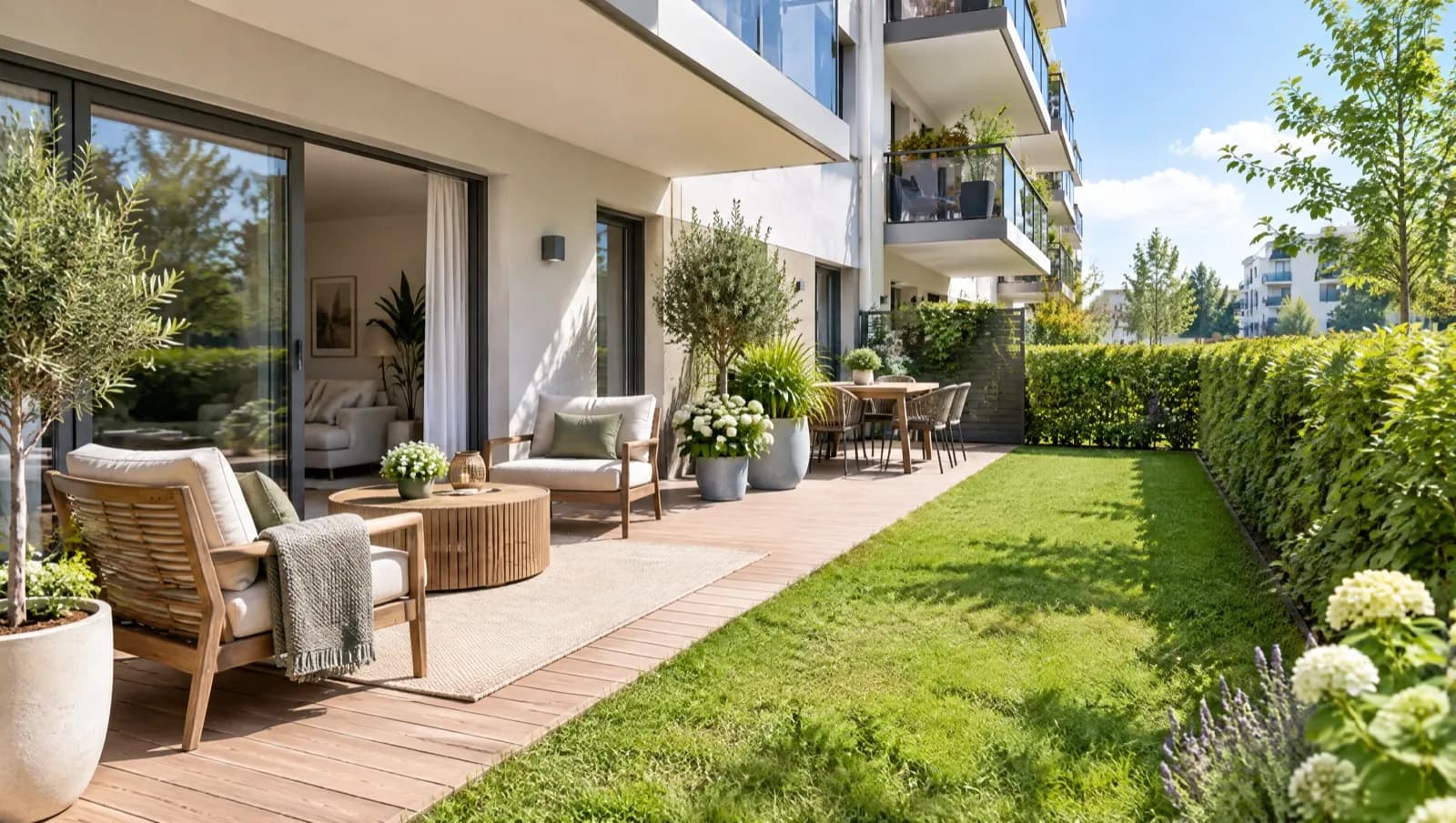
In the garden, without the association's consent you can usually: plant vegetation, lay turf, set out garden furniture and portable planters. Consent is usually required for: replacing or raising the fence, a permanent gazebo or pergola, paving the ground, felling a tree or putting up a tool shed.
Enclosing a balcony – is the association's consent needed?
Yes. Enclosing a balcony changes the façade, and the façade is part of the common property. Every owner has the right to use it jointly in line with its purpose and not to hinder others in using it (art. 12(1) and art. 13(1) of the Act on Ownership of Premises).
The procedure depends on the size of the association:
- An association of more than 3 units (a typical block) – consent to rebuilding the common property is an act exceeding ordinary management, so an owners' resolution is needed (art. 22(2) and (3)(5)). Resolutions are passed by a majority of votes counted by shares, at a meeting or by collecting votes individually (art. 23(1)–(2)).
- Up to 3 units – the Civil Code provisions on co-ownership apply (art. 19 of the Act on Ownership of Premises).
Many associations adopt one "system" resolution: one type of profile, colour and glazing division for the whole building. In that case you do not need to ask for consent individually – it is enough to follow the pattern. A resolution can be challenged in court within 6 weeks of its adoption at a meeting or of notification of a resolution adopted by individual vote collection (art. 25(1a)).
Balcony enclosure and the Building Law – permit or notification?
The Building Law defines rebuilding as works that change the functional or technical parameters of a structure, without changing its cubic capacity, built-up area, height or number of storeys (art. 3(7a)). Rebuilding buildings whose construction required a building permit – which is the case for blocks of flats – requires neither a permit nor a notification, with the exception of single-family houses as regards external partitions (art. 29(4)(1)(a), consolidated text Dz.U. 2026 item 524).
- caveat: works on a building entered in the register of monuments require a building permit, and in an area entered in the register – a notification, in both cases with the conservator's approval (art. 29(7));
- administrative authorities and courts do not always classify balcony enclosure in the same way – sometimes they treat it as a change requiring formalities, especially when it alters the look of the entire façade;
- the enclosure must not worsen fire safety or the ventilation of the flat – particularly where there is a ventilation outlet or air inlet grille on the balcony.
A safe order of steps: first the association's consent (or checking the system resolution), then a question to the architecture department of the district or city office on whether a notification is needed in your case.
Are you buying a flat and want to know before signing whether the balcony can be enclosed and whether the garden is assigned to the unit in writing? We will help you buy a flat from a developer – we will check the provisions on common parts, and for you in most cases no commission, because the developer usually pays our fee.
What is allowed without consent and what needs consent – table
| What you want to do | Whose consent | Basis / notes |
|---|---|---|
| Furniture, planters, plants, outdoor rug | Not needed | House rules (art. 13(1) of the Act on Ownership of Premises, UWL); do not overload the balustrade |
| Decking or tiles on pedestals | Usually not needed | You must not block the drain or damage the slab's waterproofing (common part) |
| Enclosing a balcony or loggia | Association (resolution); sometimes the authorities | Art. 22(3)(5) UWL; art. 29(4) and (7) of the Building Law |
| Awning, canopy, permanent shelter | Association or management board | Fixed to the façade (common property); often a pattern set by resolution |
| Protective netting (e.g. for a cat) | Depends on the house rules | Fixing to the façade usually requires the board's consent |
| Air conditioner – outdoor unit | Association | Façade and noise – details in the article on air conditioning |
| Barbecue on the balcony | Association's house rules | Fire regulations and neighbour law (art. 144 Civil Code) |
| Fence, gazebo, paving in the garden | Association | Common land (art. 3(2) UWL), quoad usum agreement |
| Changing the colour of the balustrade or façade | Association | The façade is common property |
Awning, air conditioner and barbecue on the balcony – the rules
Awning. No provision mentions it explicitly, but anchors are drilled into the façade and the awning itself changes the look of the building. Consent of the association or the board is therefore needed, and associations increasingly set one model and colour for everyone.
Air conditioning. An outdoor unit on the balcony or façade is the most common cause of disputes over noise and the look of the building. We cover the procedure, costs and rules separately in the article Air conditioning in a flat in a block.
Barbecue. The regulation on fire protection of buildings prohibits lighting a fire in a place where combustible materials or neighbouring structures could ignite (§ 4(1)(5)). A charcoal barbecue on a block balcony easily falls under this ban, and smoke may breach the rules of neighbourly coexistence – an owner should refrain from actions that disturb the use of neighbouring properties beyond the average degree (art. 144 of the Civil Code). Check the house rules before you buy the equipment.
How much does enclosing a balcony cost? A worked example
Firms price an enclosure per square metre of glazing or per running metre of balcony. Indicative ranges from price lists of Warsaw firms (September 2026): a framed enclosure from floor to ceiling – from about PLN 750/m², frameless (8 mm tempered glass) – from about PLN 1 250–1 500/m². An enclosure up to the height above the balustrade is sometimes priced as a lump sum, e.g. about PLN 1 900 for a 1.5 m balcony and about PLN 3 400 for a 3 m balcony.
| Balcony 3 m × 2.6 m high (7.8 m² of glazing) | Rate | Indicative cost |
|---|---|---|
| Framed enclosure, floor to ceiling | from PLN 750/m² | from approx. PLN 5 850 |
| Frameless enclosure, cheaper option | from PLN 1 250/m² | from approx. PLN 9 750 |
| Frameless enclosure, more expensive option | from PLN 1 500/m² | from approx. PLN 11 700 |
| For comparison: 2-room ground-floor flat in Warsaw | median PLN 16 300/m² | approx. PLN 708k |
Remember that an enclosed balcony is still a balcony – it does not become an extra room, and the floor area of the flat in the notarial deed does not change. If you are planning more finishing works, you can put together the whole budget using our guide Finishing a developer-standard flat step by step.
Flats with a garden in our offer
Developers most often design gardens for ground-floor units. According to data from the TM Invest offer, as at 27.09.2026, there are 631 ground-floor flats available in Warsaw (out of 2 237) and 321 in Wroclaw (out of 2 114). The ground floor tends to be cheaper: the median price per m² is PLN 16 300 versus PLN 18 000 for the whole offer in Warsaw, and PLN 14 335 versus PLN 15 736 in Wroclaw. The median price of a 2-room ground-floor flat is about PLN 708k in Warsaw (whole offer: PLN 756k) and about PLN 616k in Wroclaw (whole offer: PLN 662k). Most ground-floor units are in Białołęka (272) and in the Old Town of Wroclaw (113).
Not every ground-floor flat has a garden, and the price difference also results from location and floor area – ask about the garden for each specific flat. Full offer: new flats in Warsaw and new flats in Wroclaw.
A terrace in a block – arranging it without trouble with the association
A terrace on the top floor or on the roof of a lower part of the building is often at the same time the roof slab above a neighbour's flat. That is why protecting the waterproofing matters most when arranging it: do not drill into the floor, do not cover the drains, place heavy planters on pads and choose decking systems on adjustable supports that can be dismantled during an inspection.
Changes to the layout of the flat, including moving partitions or sockets on the terrace, are easiest to make while the building is still under construction – read about it in the article Layout changes with the developer. And once you have collected the keys, our checklist for moving into a new flat will help.
Frequently asked questions
Is a building permit needed to enclose a balcony?
In a block that is not a listed building, rebuilding in principle requires neither a permit nor a notification (art. 29(4)(1)(a) of the Building Law). The association's consent is, however, needed, because you are changing the façade. Since the authorities classify balcony enclosures differently, it is worth asking the office's architecture department before starting work.
Who pays for balcony repairs – the owner or the association?
The balcony structure permanently attached to the building (slab, brackets, waterproofing) is repaired by the association – this follows from the Supreme Court resolution of 7 March 2008, III CZP 10/08. The owner is responsible for day-to-day upkeep and for the elements they added themselves, such as decking or an enclosure.
Is the garden next to my flat my property?
Usually not. The garden is part of the common land, and you have the right of exclusive use of it under a quoad usum agreement. Check whether this provision is in the notarial deed or in the land and mortgage register – then the right to the garden will pass to the next buyer of the flat.
Is consent needed for an awning on the balcony?
Yes, if the awning is fixed to the façade. The façade is common property, so the consent of the association or the board is needed, and often also compliance with the pattern adopted in a resolution. A parasol or a screen attached to the balustrade without drilling usually does not require consent.
Can you barbecue on a block balcony?
A barbecue with an open flame is risky: fire regulations prohibit lighting a fire in a place where combustible materials or neighbouring structures could ignite, and smoke may infringe the neighbours' rights (art. 144 of the Civil Code). Many associations allow only electric grills in their house rules – check your own rules.
Is property tax paid on the balcony and the garden?
Tax on a flat is calculated on the usable area measured along the inner length of the walls, and on the land – from your share in the common property. A garden held under a quoad usum arrangement is therefore usually not taxed separately. You will find the 2026 rates in the article on property tax on a flat.
Summary
You can arrange a balcony, terrace and garden freely as long as you do not touch the façade, the structure or the common land. An enclosure, awning, air conditioner or new fence requires the association's consent, and in listed buildings also building formalities. When buying a flat with a garden, the most important thing is that the right of exclusive use is recorded in the notarial deed and, ideally, in the land and mortgage register.
Looking for a flat with a balcony, terrace or garden? Use our help in buying a flat from a developer – we will select units from the offer of more than 100 developments in Warsaw and Wroclaw and check the provisions on common parts. For you in most cases no commission – the developer usually pays our fee. On the market since 2016.
Legal position as at September 2026. This article is for information only and is not legal advice. How specific works are classified depends on the building, the association's resolutions and the decisions of the authorities; enclosure prices are indicative.
Sources
- Act on Ownership of Premises, consolidated text Dz.U. 2026 item 232 (art. 2, 3, 12, 13, 19, 22, 23, 25) – isap.sejm.gov.pl
- Building Law, consolidated text Dz.U. 2026 item 524 (art. 3(7a), art. 29(4) and (7)) – isap.sejm.gov.pl
- Civil Code, consolidated text Dz.U. 2026 item 795 (art. 144, 206, 221) – isap.sejm.gov.pl
- Act on Land and Mortgage Registers, consolidated text Dz.U. 2026 item 1066 (art. 16) – isap.sejm.gov.pl
- Regulation of the Minister of the Interior and Administration on fire protection of buildings, other structures and land, consolidated text Dz.U. 2023 item 822 as amended (§ 4(1)(5)) – isap.sejm.gov.pl
- Supreme Court resolution of 7 March 2008, III CZP 10/08 – thesis cited in a reply to a parliamentary question – orka2.sejm.gov.pl
- Balcony enclosure prices: indicative ranges from price lists of Warsaw firms, September 2026
- Flat prices: TM Invest development catalogue, as at 27.09.2026