












The developer's warranty for defects in Poland (rękojmia) 2026: 5 years, guarantee, how to report defects
 Author: Tacjana MasiukiewiczLaw and contracts~15 min read
The developer's warranty (rękojmia) is the statutory liability for defects in the flat: it covers physical defects found within 5 years of the day the unit was handed over, and the developer cannot limit these rules in an agreement with a consumer. A guarantee is something different – a voluntary promise whose terms are set by the guarantor. Below: what the warranty covers, how it differs from a guarantee, how to report a defect (a model letter), the deadlines and the common areas.
Key facts
- The developer is liable under the warranty for physical defects in the flat found within 5 years of the day the unit was handed over (Art. 568 § 1 of the Civil Code).
- You can demand that the defect be removed, and also submit a statement on a price reduction or – for a material defect – on withdrawal from the agreement (Art. 560–561 of the Civil Code).
- If, as a consumer, you demand a repair or a price reduction by a stated amount and the developer does not reply within 14 days, it is deemed to have accepted the demand (Art. 5615 of the Civil Code).
- The claim for removal of a defect lapses one year after it was found, but for a consumer not before the end of the 5-year warranty period (Art. 568 § 2 of the Civil Code).
- A guarantee is voluntary; if the document sets no period, it is 2 years from handing over the item (Art. 577 § 4 of the Civil Code) and works independently of the warranty.
The developer's warranty – where does it come from and how long does it last?
The Developer Act regulates in detail only the handover of the flat and defects reported before the deed transferring ownership (Art. 41). In all other respects the developer's liability for physical and legal defects is governed accordingly by the Civil Code provisions on the statutory warranty in sales (Art. 41a of the Developer Act). Provisions of the agreement less favourable to the buyer than the Act are void (Art. 42), and in an agreement with a consumer, limiting or excluding the warranty is permissible only in the cases stated in special provisions (Art. 558 § 1 of the Civil Code). How to read the whole agreement is described in the guide Polish developer agreement (umowa deweloperska).
For real estate the warranty period is 5 years from the day of handover of the unit to the buyer – in practice from the date of the handover report (the handing over of the keys), not from the date of the building's occupancy permit. This matters for completed flats: if you buy a unit in a building put into use two years ago, your 5 years run from the day the developer handed the flat over to you.
Since 1 January 2023, a lack of conformity of goods with the contract has been regulated for consumers by the Consumer Rights Act, but "goods" there means movable items – for a flat, the warranty under the Civil Code still applies.
Does the warranty also apply to buyers "through a company"?
Yes. An individual running a business, for whom the purchase is not of a professional nature, is treated as a consumer (Art. 5564 of the Civil Code). A business buying professionally may have the warranty limited in the agreement and must notify the defect without delay (Art. 563 of the Civil Code).
What does the warranty on a flat from a developer cover?
A defect is a non-conformity of the unit with the agreement (Art. 5561 of the Civil Code) – including with the developer's assurances in the prospectus or the finish standard. The developer is liable for defects that existed at the time of handover or arose from a cause inherent in the unit at that time (Art. 559 of the Civil Code) – even if they show up only after several years. Typical defects in a new flat after handover are:
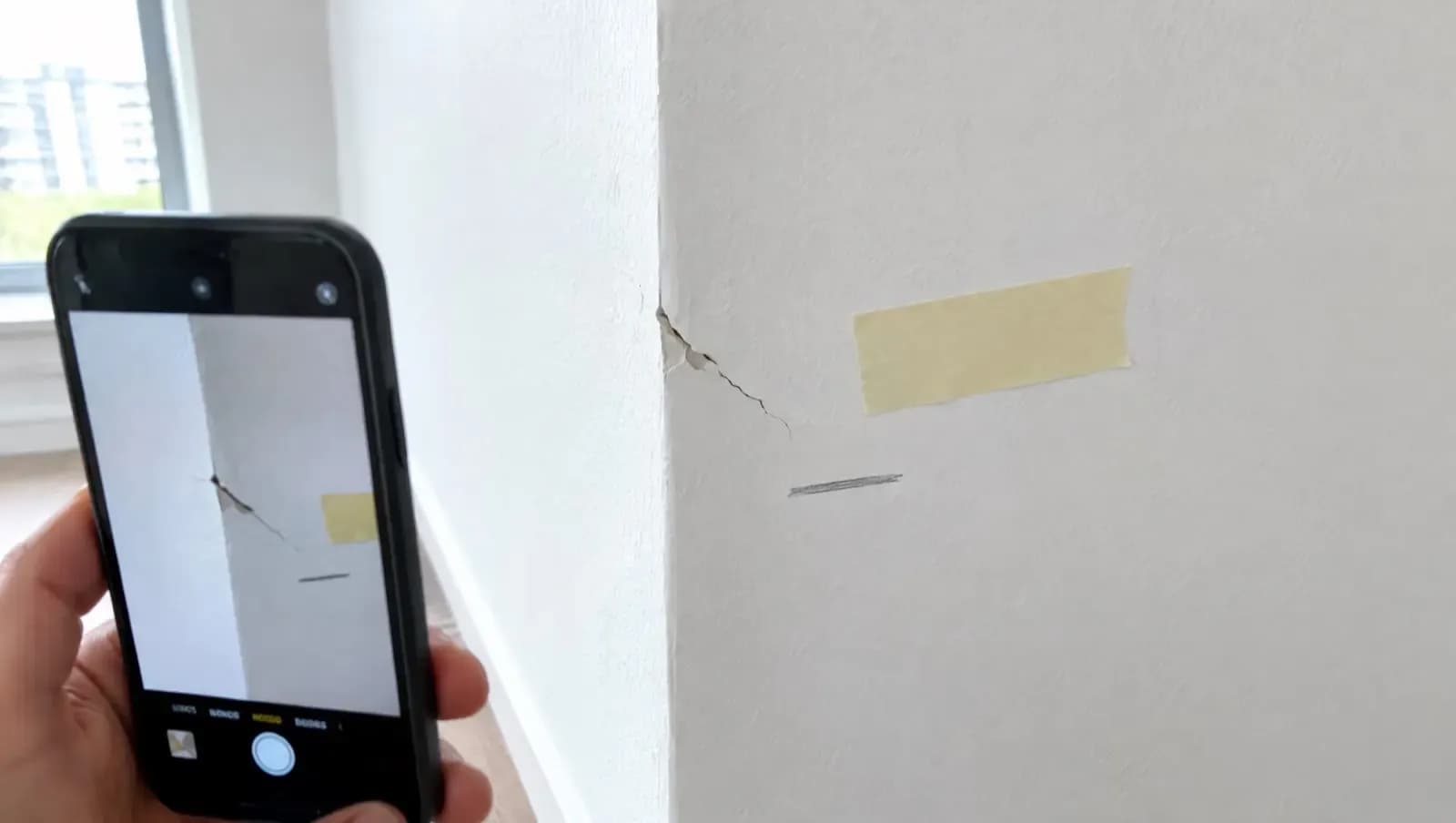
- cracks in plaster and screeds, delamination, damp and mould blooms,
- leaking windows and balcony doors, frozen corners, thermal bridges,
- leaks from a balcony or terrace, faulty falls and flashings,
- defects of the installations: heating, ventilation, electrics, sewage,
- legal defects – for example the unit being encumbered with a third party's right (Art. 5563 of the Civil Code).
The warranty does not cover wear and tear, damage caused by you or your contractors, or the effects of poor use (for example ventilation grilles taped over). A defect found within a year of handover is presumed to have existed at handover (Art. 5562 of the Civil Code) – later the burden of proof is on you, hence the value of photos from day one.
Guarantee vs warranty – how do they differ?
A developer does not have to give a guarantee. If it does, it does so through a guarantee statement that sets out the guarantor's obligations and your rights (Art. 577 § 1 of the Civil Code). You can ask for the guarantee document on paper or another durable medium (Art. 5772 of the Civil Code). Guarantees from the manufacturers of windows, doors or ventilation units are common.
| Criterion | Warranty (rękojmia) | Guarantee |
|---|---|---|
| Source | the law (Civil Code + Art. 41a of the Developer Act) | a voluntary statement by the guarantor |
| Who is liable | the developer (the seller) | the guarantor – the developer, manufacturer or contractor |
| Time | defects found within 5 years of handover of the unit | the period from the document; if none – 2 years from handover |
| Rights | repair, price reduction, withdrawal (material defect), compensation | those described in the guarantee (usually repair or replacement) |
| Reaction time | 14 days to reply to a consumer's demand (Art. 5615) | the period from the guarantee; if none – up to 14 days from delivering the item (Art. 580 § 2) |
| Can it be limited | against a consumer – only in cases under special provisions | the guarantor sets the scope itself |
The two routes work independently: using a guarantee does not take away your warranty, and for the duration of the guarantee procedure the running of the warranty period is suspended (Art. 579 of the Civil Code).
What are your rights – repair, price reduction, withdrawal?
- Removal of the defect – the developer must repair it within a reasonable time, without excessive inconvenience to you and at its own cost, including labour and materials (Art. 561 § 2 and Art. 5613 of the Civil Code).
- A price reduction – proportionate: the reduced price relates to the price in the agreement as the value of the unit with the defect relates to its value without the defect (Art. 560 § 3 of the Civil Code).
- Withdrawal from the agreement – only where the defect is material (Art. 560 § 4 of the Civil Code). It is a last resort for defects that prevent normal use of the flat.
- Compensation – after a price reduction or withdrawal you can claim compensation for damage, including reimbursement of the costs of concluding the agreement and of outlays (Art. 566 of the Civil Code).
The developer can "block" a price reduction or withdrawal by promptly removing the defect – unless it has already tried to repair it or failed to carry out the repair (Art. 560 § 1 of the Civil Code). Withdrawal under the warranty after the deed is something different from withdrawal from the developer agreement before ownership is transferred – the latter we describe in the article Withdrawing from a developer agreement.
Example: how large can a price reduction be?
Take a 2-room flat for 662 405 zł – the median price of a two-room flat in Wrocław according to TM Invest offer data, as of 27.09.2026. Suppose an expert values the unit without the defect at 700 000 zł, and with the defect (for example a permanently freezing gable wall) at 679 000 zł – that is 3% less. The reduced price: 662 405 zł × 679 000 / 700 000 = 642 533 zł, so the developer should return about 19 872 zł. In Warsaw, with a median for 2 rooms of 755 824 zł, the same proportion would give about 22 675 zł. In a dispute over the amount, an expert's opinion usually decides.
Already have a draft agreement and want to know what the developer wrote about defects, guarantees and repair deadlines? We will check the draft agreement and the developer's documents and point out provisions to negotiate before you go to the notary.
How to report a defect to the developer – a step-by-step model letter
The form is free, but a letter (registered post with proof of receipt, or an e-mail to the address from the agreement) gives you proof of the date from which the 14 days to reply run. The developer's defects portal – yes, but send important demands in writing too. A complaint to the developer should contain:
- the place and date, your details and the developer's details (name, address, KRS from the agreement),
- a title: "Report of a physical defect in the unit – a demand under the warranty",
- identification of the unit: the address, the unit number, the land and mortgage register number, the date of the notarial deed and the date the unit was handed over,
- a description of the defect: where it occurs, what it consists of, since when you noticed it (the date the defect was found),
- the basis: Art. 41a of the Developer Act in conjunction with Art. 556 et seq. of the Civil Code,
- a specific demand: removal of the defect within a set, reasonable time – or a price reduction by a stated amount,
- a proposal of dates when the unit will be available for inspection,
- a list of attachments: dated photos, recordings, a copy of the handover report, possibly a specialist's opinion,
- a signature.
Remember: the 14-day presumption of acceptance under Art. 5615 of the Civil Code works only if you demand a repair or a price reduction stating the amount. A mere "I am informing you of a defect" does not trigger it.
Photo documentation and deadlines – in practice
- Photograph the whole flat on the day of handover – including the installations before they are boxed in.
- Photograph defects with a tape measure or a level; for damp, note the dates and the weather.
- Keep a register of reports: the dates sent, replies and repairs.
- After a repair, write a report – if the defect recurs, you can demand a price reduction straight away.
Defects found at handover and up to the deed transferring ownership are handled under Art. 41 of the Developer Act (14 days to reply, 30 to remove) – see Handover of a flat from a developer. The more you catch then, the less is left for the warranty – a technical handover with an inspector (in Polish) helps.
Deadlines and limitation – an example with dates
There are two periods: 5 years to find the defect and a year to pursue the repair from when it was found – for a consumer no shorter than to the end of the 5 years (Art. 568 § 1–2 of the Civil Code). Within the same periods you submit a statement on a price reduction or withdrawal (Art. 568 § 3 of the Civil Code). If the developer fraudulently concealed the defect, the passing of 5 years does not close the route to you (Art. 568 § 6 of the Civil Code).
| Situation (consumer, unit handed over on 15.10.2026) | By when you must act |
|---|---|
| End of the period for finding a defect | 15.10.2031 |
| A defect found on 1.03.2027 – a claim for repair | the year would end on 1.03.2028, but for a consumer not earlier than 15.10.2031 |
| A defect found on 1.09.2031 – a claim for repair | 1.09.2032 (a year from finding it) |
| A repair demand sent and received on 2.03.2027 | no reply by about 16.03.2027 = the demand accepted (Art. 5615) |
When the developer delays the repair, set a final deadline in writing, and then consider a price reduction, mediation or a lawsuit. We write about other delays in the article Developer delay – contractual penalties and compensation (in Polish).
Common areas – the warranty and the owners' association
The roof, the façade, the staircases, the underground car park or the installation risers are common property – the land and the parts of the building that do not serve exclusively the owners of individual units (Art. 3(2) of the Act on the Ownership of Premises). Warranty claims, however, arise from the agreements each buyer concluded with the developer, so they belong to the owners individually. An owners' association (wspólnota mieszkaniowa) can acquire rights and sue (Art. 6 of that Act), and the Supreme Court in a resolution of seven judges of 29 January 2014 (III CZP 84/13) held that an owner may assign to the association their warranty rights for defects in the common property.
In practice, defects in the common areas are reported by the association's management board or manager, and for serious defects the owners conclude assignment agreements with the association. Mind the transitional period: as long as the developer holds a majority of shares, resolutions are passed mainly with its votes (voting by shares – Art. 23(2) of the Act on the Ownership of Premises). So keep an eye on reports yourself too – your 5-year warranty period runs from the handover of your unit.
Tenant changes, your own crew and the developer's insolvency
Tenant changes (zmiany lokatorskie) made by the developer under an annex are, as a rule, covered by the warranty like the rest of the unit – keep the annex and the design of the changes. More in the article Tenant changes at the developer (in Polish).
Your own finishing crew is the most common source of disputes. The developer is not liable for damage caused by your contractors (for example a drilled-through cable) and often claims the defect arose during finishing. Document the condition of the walls and floors before the work, and settle with the contractor under their agreement – see The finishing crew – the agreement (in Polish).
The developer's insolvency after ownership has been transferred complicates matters: warranty claims are filed in the bankruptcy proceedings, and their satisfaction is sometimes partial. The Developer Guarantee Fund protects buyers' payments before ownership is transferred, not the cost of repairs after the deed (see escrow account and DFG). Then check the manufacturers' and contractors' guarantees – we will discuss that scenario separately.
A completed flat or one under construction – what does it change for the warranty?
According to TM Invest offer data, as of 27.09.2026, in Warsaw we have 37 developments already put into use (673 flats available in them), and in Wrocław 24 such developments (428 flats). In a completed building you can see the common areas after the first winters and ask the owners' association about reported defects – and the warranty on your unit counts from its handover to you anyway. Browse new flats in Warsaw and new flats in Wrocław.
Frequently asked questions
How many years does the warranty on a flat from a developer last?
Five years from the day the unit was handed over – within that time a physical defect must be found. The claim for repair itself lapses a year after the defect was found, but for a consumer not before those five years have passed.
How long does the developer have to reply to a complaint?
14 days. If, as a consumer, you demanded removal of a defect or a price reduction by a specific amount and the developer did not respond in that time, it is deemed to have accepted the demand as justified (Art. 5615 of the Civil Code). The repair itself is to be carried out within a reasonable time.
Can the developer send me to the contractor or the manufacturer?
The developer is liable under the warranty as the seller – you can report defects directly to it. A manufacturer's or contractor's guarantee is an additional route that you may, but do not have to, use.
Who reports defects in the building's common areas?
Usually the association's management board or manager, who collects the residents' reports. The warranty rights, however, belong to the individual owners – the association can pursue them if the owners assign them to it by an assignment agreement.
Summary
The developer's warranty gives you 5 years from the handover of the flat to find defects and real tools: repair at the developer's cost, a price reduction and, for a material defect, withdrawal from the agreement. A guarantee may supplement these rights but does not replace them. The key is photos from the day of handover, written reports with a specific demand and keeping to the 14-day deadline.
Buying a flat from a developer? We will help you choose a flat and go through the whole purchase – usually with no commission for the buyer, as the fee is typically paid by the developer. Before you sign, we will check the developer agreement, including the provisions on handover, defects and the guarantee.
Legal status as of September 2026. The calculations are indicative, and the article is for information only and does not constitute legal advice.
Sources
- Civil Code (in Polish) – consolidated text, Dz.U. 2026 item 795 (Art. 556–568, 577–581).
- Act on the protection of the rights of a purchaser of a residential unit or a single-family house and on the Developer Guarantee Fund (in Polish) – consolidated text, Dz.U. 2026 item 880 (Art. 41, 41a, 42).
- Act on the Ownership of Premises (in Polish) – consolidated text, Dz.U. 2026 item 232 (Art. 3, 6, 23).
- Consumer Rights Act (in Polish) – consolidated text, Dz.U. 2026 item 1244 (Art. 2(4a), Art. 43a – the provisions on goods concern movable items).
- Resolution of a panel of seven judges of the Supreme Court of 29 January 2014, III CZP 84/13.
- Flat prices: TM Invest developments catalogue, as of 27.09.2026.