












Mortgage in Poland with a TM Invest expert
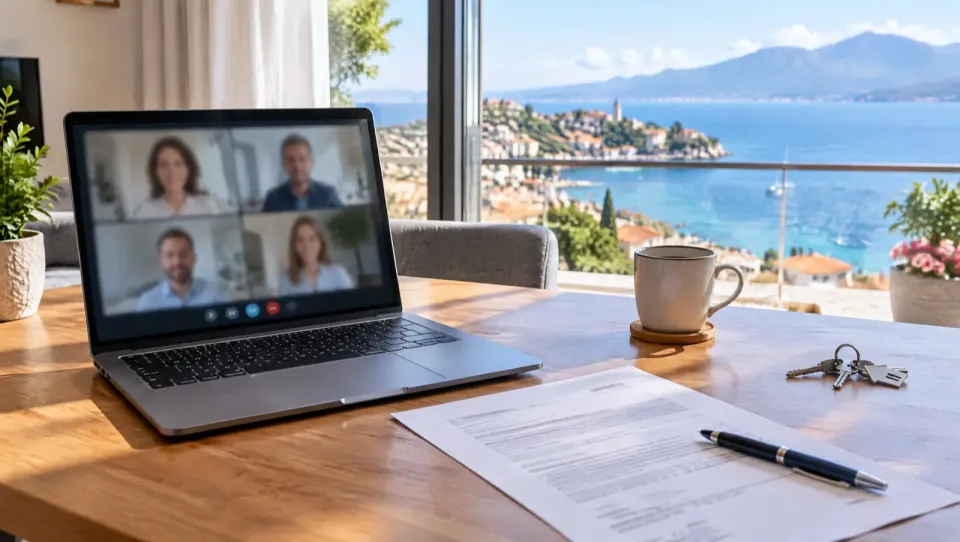
A TM Invest mortgage expert checks your borrowing capacity, compares mortgage offers from several banks and guides you all the way to the loan agreement. Mortgages in Warsaw, in Wrocław and remotely.
- Bank offers compared
- Support until you sign
- Warsaw, Wrocław, remotely
- 4,8/5 on Google272 client reviews
- Since 2016on the market
- Offers from several bankswith one set of documents
- Warsaw and Wrocławplus remote meetings
Mortgage calculator
Work out an indicative monthly payment, or see how much you could borrow – in the second tab.
Choose the terms that suit you
- Down payment —
- Loan amount —
- Total interest—
- Total to repay (loan + interest)—
- Last instalment—
- Monthly payment if the interest rate rises by 2,5 percentage points —
- Interest rate
- Instalments
- Loan term
These calculations are indicative examples only. They do not include arrangement fees, insurance or other loan costs, so they do not show the APRC (RRSO). They are not a loan offer — the bank decides on the loan and its terms after assessing your borrowing capacity, and the details are set out in the bank’s information sheet (Formularz Informacyjny).
Ask about a mortgageGet an estimate of how much you could borrow
- Instalment limit —
- Current instalments and limits —
- Income left over —
- Monthly payment for this amount —
- Apartment up to approx. (with a 20% down payment)—
- Loan term used—
- Limiting factor—
What affects your borrowing capacity?
- Income and type of employment
- Other loans and instalments
- Card limits and overdrafts – even unused ones count
This is an estimate — every bank calculates borrowing capacity differently.
Banks take into account, among other things, your type of employment contract and length of employment, your credit history in BIK, their own cost-of-living figures and a buffer for rising interest rates. Our mortgage expert will check your exact borrowing capacity.
How do we calculate?
- Instalment limit: the lower of two amounts — 40% of net income (if income per borrower is up to approx. 7 000 zł) or 50% (above that), or income minus living costs (approx. 2 086 zł for the first person and approx. 1 422 zł for each additional person; every borrower counts as a household member) and minus 2% of income; from this limit we deduct instalments on other loans and 5% of granted card and overdraft limits. The “Limiting factor” row shows which amount applies.
- The loan amount is the sum that can be repaid within the instalment limit in equal instalments at an interest rate of 8,07% — an indicative variable rate (5,57%) plus a 2,5 pp buffer that banks apply when assessing borrowing capacity.
- The 40% and 50% thresholds follow Recommendation S of the Polish Financial Supervision Authority (KNF): all instalments should not exceed 40% of income for clients earning up to the average salary in their voivodeship, and 50% for others. We conservatively set the threshold at approx. 7 000 zł net per borrower — more in the article “Zdolność kredytowa” (in Polish).
- The loan term is at most 35 years and cannot extend beyond the oldest borrower’s 75th birthday.
- We assume an employment contract (umowa o pracę), standard expenses and no other obligations (e.g. maintenance payments).
Already have an apartment in mind? The mortgage calculator is also on the page of every apartment in our catalogue.
How we work
- Consultation with an expert We talk about your income, your down payment and your plans for buying an apartment.
- Borrowing capacity and offer comparison We estimate roughly how much you could borrow, line up offers from several banks and choose a loan programme that fits.
- Application and documents We draw up the list of documents for your situation and help you prepare applications to the banks you choose.
- Decision and loan agreement We stay with you until you sign the loan agreement and buy the apartment.

What you get
- One set of documents You use it to apply to several banks.
- No down payment? We check whether you qualify for the BGK guarantee and whether the apartment is within the programme limits.
- Mortgage and apartment in one place In our catalogue: 204 developments, 8 983 apartments.
- We know the primary market We work with developers' offers every day, so we know how banks finance an apartment under construction: tranches and the escrow account.
Talk to a mortgage expert
The consultation comes with no obligation. Choose what suits you: a short quiz about your situation, or just your phone number.
Check your borrowing capacity with an expert
4 short questions — a mortgage expert will call you back with specific information, with no obligation.
Step 1 of 4
Mortgage guide
The key facts before you apply – with sources and links to our articles.
Fixed or variable interest rate – pros and risks
The type of interest rate decides whether you know your monthly payment for the next few years or whether it moves with the market. You can compare both options in the calculator above.
Fixed rate (fixed for a period)
The rate is set for several years – usually 5 years or longer. After that period, the bank offers a new fixed rate or the loan switches to a variable rate.
Pros
- A predictable monthly payment for the whole fixed-rate period.
- Rising interest rates during that time will not increase your payment.
- When assessing your borrowing capacity, banks usually apply a lower interest rate buffer than for a variable rate.
Risks
- On the day you sign, a fixed rate can be higher than a variable one.
- If rates fall, your payment will not go down until the fixed-rate period ends.
- The new rate after the period ends depends on the market at that time.
Variable rate
The interest rate is the sum of a reference rate (e.g. WIBOR) and the bank's margin, which usually stays the same for the whole term of the loan. Your payment changes together with the reference rate.
Pros
- Falling interest rates lower your payment.
- The initial payment can be lower than with a fixed rate.
Risks
- A rise in the reference rate increases your payment and the total amount you repay.
- The bank calculates your borrowing capacity with a buffer for rising rates (at least 2,5 percentage points), so the maximum loan amount may be lower.
For a variable rate, the calculator also shows your payment after a 2,5 percentage point rise in the rate – a simple test of whether your budget can cope with an increase. More on how banks calculate borrowing capacity: Borrowing capacity – how much can I borrow (in Polish).
What APRC (RRSO) is and what makes up the total cost of a mortgage
The interest rate alone only shows the cost of interest. To compare offers, use the APRC (annual percentage rate of charge, in Polish RRSO). It is the total cost of the loan expressed as an annual percentage, calculated with a single formula set out in the Polish Mortgage Credit Act. This lets you compare offers with different arrangement fees, margins and add-on products.
- Interest resulting from the interest rate: the bank's margin plus the reference rate, or the fixed rate
- Arrangement fee for granting the loan – 0 zł in some offers, usually in exchange for other terms
- Insurance required by the bank, e.g. property, life or low down payment insurance
- Property valuation – a valuation report (operat szacunkowy) ordered by the bank
- Other charges, e.g. for an account required by the offer and the tax on establishing the mortgage
Total amount payable = loan amount + total cost of the loan. The total cost of the loan does not include, among other things, notary fees. The bank must state the APRC and the total amount payable in a representative example and in the information form – compare them for the same loan amount and the same loan term.
Source: Act of 23 March 2017 on mortgage credit (in Polish). Our calculator shows the payment and interest without the arrangement fee and insurance, which is why it does not give the APRC. Other purchase costs (notary, court, taxes): Costs of buying an apartment from a developer.
No down payment? The BGK guarantee (family housing loan)
As a rule, a bank finances up to 80% of the apartment's value, so you need a down payment of about 20%. A loan with a 10% down payment is also possible if the missing part is additionally secured – most often with low down payment insurance (Recommendation S of the KNF, the Polish Financial Supervision Authority). If you have no savings, look at the family housing loan (rodzinny kredyt mieszkaniowy).
- A guarantee instead of a down payment Bank Gospodarstwa Krajowego (BGK), the Polish state development bank, guarantees repayment of the part of the loan that corresponds to the missing down payment – up to 100 000 zł. The loan can finance even the full price of the apartment.
- Who it is for People who do not own an apartment or a house. Families with at least two children may own one apartment of limited floor area.
- Family repayment When a second child is born, BGK repays 20 000 zł of the loan, and for a third and each subsequent child – 60 000 zł.
- Conditions A loan term of at least 15 years, a one-off guarantee fee of 1% of the guaranteed amount (max. 1 000 zł), price limits per m². Banks grant these loans until 31 December 2030.
Loans with the guarantee are offered by several banks that work with BGK. Our mortgage expert will check whether you meet the programme conditions and whether the apartment you have chosen is within the limits.
Sources (as of September 2026): BGK – down payment guarantee, gov.pl – An apartment without a down payment (both in Polish). More: Down payment – how much you need, Housing programmes 2026 (in Polish).
What documents you need for a mortgage
This list is indicative – every bank has its own forms and may ask for other documents. Certificates from your employer, from ZUS (the Social Insurance Institution) and from the tax office are valid only for a short time, so collect them just before you apply.
Employment contract
- Identity document.
- Certificate of employment and salary – on the bank's form, completed by your employer.
- Statement of the account your salary is paid into.
- Tax return for the last year (e.g. PIT-37), if the bank asks for it.
Self-employed (sole trader, B2B)
- Identity document.
- Certificates from ZUS and the tax office confirming you have no arrears in contributions or taxes.
- Tax documents matching your form of taxation, e.g. PIT tax return, revenue and expense ledger or revenue records.
- The bank's form with information about your business.
Apartment from a developer
- Developer agreement (umowa deweloperska) or its draft, or a reservation agreement (umowa rezerwacyjna).
- Development documents the bank asks for, e.g. an extract from the land and mortgage register (księga wieczysta), the building permit, the developer's details from the National Court Register (KRS).
- Proof that you have the down payment.
Source: a sample bank document list – Bank Pekao, mortgage guide (in Polish). Our mortgage expert will prepare the full list for your situation. The whole process: Mortgage step by step.
How long the mortgage process takes
- Borrowing capacity and choice of offer We check your borrowing capacity, compare offers and draw up the list of documents. How long this takes depends mainly on how quickly you collect them.
- Application and valuation The bank reviews your application and orders a valuation of the apartment (operat szacunkowy).
- Credit decision The Mortgage Credit Act gives the bank 21 days from the application to make its decision.
- Time to think it over A positive decision binds the bank for at least 14 days – you can calmly compare it with other offers.
- Agreement and payout You can withdraw from the signed agreement within 14 days. For an apartment under construction, the bank pays out the loan in tranches into the developer's escrow account (rachunek powierniczy).
Source: Act of 23 March 2017 on mortgage credit (in Polish). In detail: Mortgage step by step, Escrow account and the Developer Guarantee Fund (DFG) (in Polish).
Frequently asked questions
Do I pay you for help with getting a mortgage?
No. You do not pay us a commission – the fee for credit intermediation is paid by the bank you sign the loan agreement with. More: how a mortgage expert works (in Polish).
Equal or decreasing instalments – which should I choose?
Equal instalments stay the same (as long as the interest rate does not change), so the first payment is lower and it is easier to borrow a larger amount. With decreasing instalments, the capital part is fixed – the first payments are higher, but you pay less interest in total. An example from the calculator: a loan of 439 312,50 zł over 30 years at 6,8% means an equal instalment of 2 863,99 zł or a first decreasing instalment of 3 709,75 zł; total interest comes to about 591,7 thousand zł and about 449,3 thousand zł respectively.
How many years should my mortgage be for?
KNF Recommendation S states that the loan term should not exceed 35 years. A longer term means a lower monthly payment and a higher borrowing capacity, but more interest in total. You can check the difference in the calculator – for example, change the term from 25 to 30 years.
Does a credit card limit reduce my borrowing capacity?
Yes. Banks treat the limits granted on your cards and overdrafts as a liability – even if you do not use them – and add part of the limit to your monthly repayments (5% of the limit in our calculator). Closing cards and limits you do not need before you apply may increase your borrowing capacity.
Can I buy an apartment with a 10% down payment?
Yes. KNF Recommendation S allows a loan of up to 90% of the property's value if the part above 80% is additionally secured – most often with low down payment insurance. Its cost is usually borne by the borrower, e.g. as a one-off premium or a higher margin until part of the loan has been repaid. With no down payment at all, you can use the BGK guarantee under the family housing loan.
What happens when the fixed-rate period ends, e.g. after 5 years?
Before the period ends, the bank offers a new fixed rate for the next period. If you do not accept it, the loan usually switches to a variable rate – the reference rate plus the margin in your agreement. Your payment will then depend on interest rates at that time.
Can you guarantee that my mortgage will be approved?
No. The credit decision is always made by the bank. We will help you choose banks and prepare a complete application.
Can the consultation take place remotely?
Yes, some matters can be arranged by phone or email. You are also welcome at our office at ul. Cybernetyki 9 in Warsaw.
Didn't find your answer? Ask a mortgage expert
We will call you back and arrange a convenient time – at our office at ul. Cybernetyki 9 in Warsaw or remotely.