











Selling a flat step by step 2026 – documents, taxes, contracts
 Author: Tacjana MasiukiewiczSelling~15 min read

Selling a flat step by step is usually 10 stages: checking the legal status and documents, valuation, preparing the unit, the listing, negotiations, a preliminary agreement with a deposit, the buyer's mortgage, the notarial deed, handing over the unit and settling the tax. You have the most formalities at the start and the end, and the biggest costs — the notary fee and PCC — are customarily borne by the buyer. Below we describe each stage, show a table of the seller's costs, current NBP transaction prices and an example of the tax calculation.
Key points
- A flat sale agreement must be in the form of a notarial deed (Art. 158 of the Civil Code); a preliminary agreement can be made in ordinary written form, but only a notarial deed gives the right to demand the conclusion of the final agreement in court.
- Since 28 April 2023 the seller must give the buyer an energy performance certificate at the notarial deed — the buyer cannot waive this right.
- The maximum fee for a sale agreement for a residential unit is half the rate from § 3 of the regulation (e.g. PLN 2,025 net at a price of PLN 820k), and 2% PCC is paid by the buyer — unless they are buying a first flat.
- A sale before 5 years have passed from the end of the year of acquisition means 19% tax on income and PIT-39 by 30 April of the following year — unless you use the housing relief (ulga mieszkaniowa).
- The average transaction price on the secondary market in Q2 2026 according to NBP: PLN 16,723/m² in Warsaw and PLN 12,590/m² in Wrocław.
Selling a flat step by step – 10 stages in one table
The table below is a map of the whole process. The duration of the stages is indicative — it depends on the market, the price and whether the buyer finances the purchase with a loan. In the costs column we give only expenses the seller usually bears.
| Stage | Time (indicative) | Documents | Seller's costs |
|---|---|---|---|
| 1. Legal status and documents | 1–3 weeks | land register (KW) number, the basis of acquisition (deed, inheritance decision), certificates from the community or cooperative | copies and certificates (online KW extract from PLN 30) |
| 2. Valuation | a few days | size, floor plan, technical condition | optionally a valuer's report |
| 3. Preparing the unit | 1–4 weeks | energy performance certificate | the certificate, small repairs, photos, possibly home staging |
| 4. Listing or agency | start within a few days | brokerage agreement (with an agency) | a possible broker's commission |
| 5. Viewings and negotiations | from a few weeks to a few months | – | – |
| 6. Preliminary agreement and deposit | 1–2 weeks | draft agreement, documents from stage 1 | the fee if the agreement is notarial (split to be agreed) |
| 7. The buyer's mortgage | usually a few weeks | documents for the buyer's bank, a certificate from your bank on the loan balance | – |
| 8. Notarial deed | 1 visit | ID card, the basis of acquisition, the energy certificate | customarily none (the buyer pays the fee and PCC) |
| 9. Handing over the unit | by the date in the deed | handover protocol, meter readings | deletion of the mortgage PLN 100 (if there was one) |
| 10. Tax | by 30 April of the following year | PIT-39 (sale before 5 years have passed) | 19% of income; no tax after 5 years or with full relief |
Steps 1–2: legal status, documents and valuing the flat
Check what you are actually selling
Start with the land register: are you entered in it as the owner, is there a mortgage in section IV and are there entries that will put a buyer off. Selling a unit with separate ownership looks different from selling a cooperative ownership right without a register — then the key is a certificate from the cooperative. You will find the full list for each variant in the article Documents for selling a flat.
Two situations require extra steps before you list the offer. If you inherited the flat, you first need a declaration of acquisition of the estate, and with several heirs the consent of all or a division of the estate (we describe this in the text Selling an inherited flat step by step, in Polish). If the unit is co-owned by former spouses, a sale requires the consent of both or a prior division of property — see Selling a flat after a divorce and with co-ownership (in Polish). If you cannot be at the notary in person, prepare a power of attorney for the sale.
Valuation: NBP data and competition from the primary market
The asking price decides the speed of sale more than photos do. The reference point is transaction prices, not offer prices — in Warsaw the difference between them according to NBP in Q2 2026 is about PLN 2.3k per metre. Your buyer also compares your offer with new flats, so we set NBP data against medians from our project catalogue (according to the TM Invest offer as of 27 September 2026).
| Indicator (PLN/m²) | Warsaw | Wrocław |
|---|---|---|
| Secondary market – average offer price, Q2 2026 (NBP) | 19,059 | 13,529 |
| Secondary market – average transaction price, Q2 2026 (NBP) | 16,723 | 12,590 |
| Primary market – average transaction price, Q2 2026 (NBP) | 16,783 | 14,312 |
| New flats in the TM Invest offer – median offer price | 18,000 | 15,736 |
| 2-room flat in the TM Invest offer – median price | PLN 755,824 (39.4 m²) | PLN 662,405 (40.8 m²) |
What follows from this? A used 2-room flat of 39.4 m² in Warsaw, valued at NBP's average transaction price, costs about PLN 659k (39.4 × 16,723), roughly PLN 97k less than the median of a new 2-room flat in our offer. In Wrocław the difference is larger: 40.8 m² × 12,590 is about PLN 514k against a median of PLN 662k for a new one. If you ask a price close to the primary market, you must justify it with location, condition or standard — otherwise the buyer will choose a new flat. How to estimate the value yourself is covered in the article How much is my flat worth? (in Polish), and when to order a valuer's report in the text A valuation report – how much a valuer's assessment costs (in Polish).
Steps 3–5: preparation, the listing and negotiations
Before publishing the listing, order an energy performance certificate. The obligation to prepare it on sale follows from Art. 3 of the Act on the energy performance of buildings, and the obligation to hand it to the purchaser at the deed from Art. 11. The certificate is generated from a central register and valid for 10 years, so if you have a current one you do not need a new one. If a certificate exists, the listing should state the energy demand indicators (Art. 13).
Then preparing the unit: small repairs, tidying, good photos in daylight, a floor plan with dimensions. Proven ways to shorten the time to sell — from setting the price to home staging — are collected in the article How to sell a flat quickly (in Polish). Next you decide whether to sell yourself or with a broker. You will find a comparison of costs, time and risk in the text Selling through an agency or yourself? (in Polish), and the rates in both cities in the article Estate agency commission in Warsaw and Wrocław (in Polish).
In negotiations, besides the price you agree the date of the deed, the date of handing over the unit, the amount of the deposit and what stays in the flat (furniture, appliances). Write these arrangements down — they will go into the preliminary agreement.
Do not want to go through this alone? Order a valuation and a sale plan — we will help prepare the flat, set the price and carry out the sale through to the notarial deed.
Steps 6–7: the preliminary agreement, the deposit and the buyer's mortgage
A preliminary agreement must specify the essential terms of the sale agreement: the parties, the unit, the price (Art. 389 of the Civil Code). It is also worth writing in the date for concluding the final agreement. The form matters: if the preliminary agreement is in the form of a notarial deed and the other party withdraws, you can demand in court that the sale agreement be concluded (Art. 390 § 2). With ordinary written form, damages remain.
A deposit (zadatek) protects both sides: if the buyer does not perform the agreement, you can withdraw from it and keep the deposit; if you withdraw, the buyer can demand twice the deposit (Art. 394 § 1). An advance payment (zaliczka) does not play that role — it is refundable. Details, including typical deadlines and pitfalls, are described in the article The preliminary agreement for selling a flat (in Polish).
Most buyers finance the purchase with a loan, so in the preliminary agreement allow time for the bank's decision. The buyer's bank will ask you for the unit's documents, and if your flat is encumbered with a mortgage — for a certificate from your bank on the debt balance and consent to deleting the mortgage after repayment. The whole mechanism (repaying your loan with the buyer's money) is described in the guide Selling a flat with a mortgage (in Polish).
Step 8: selling a flat at the notary – who pays the notary?
The regulations do not say which party must pay the notary — the remuneration is set by agreement of the notary with the parties, within the maximum rates (Art. 5 of the Notary Act). Customarily, when a flat is sold, the buyer pays the fee, the court fees for the ownership entry and PCC tax. PCC is by law the buyer's obligation (Art. 4(1) of the PCC Act), and when a natural person buys a first flat, an exemption applies. We write more about the rates in the articles Notary fees 2026 and PCC tax on buying a flat.
Example: a 50 m² flat in Warsaw for PLN 820,000 (about PLN 16,400/m², close to NBP's average transaction price):
- maximum fee: § 3 of the regulation = PLN 1,010 + 0.4% × PLN 760,000 = PLN 4,050; for a sale agreement for a residential unit half of that, i.e. PLN 2,025 net + 23% VAT = PLN 2,490.75 (plus copies);
- PCC 2% = PLN 16,400 — the buyer will not pay it at all if they acquire a first flat;
- ownership entry in the land register: PLN 200;
- on the seller's side: with a mortgage, deletion PLN 100 (half the fee for an entry). Details of court fees: Court fees when buying a flat.
Bring your ID card, the acquisition document and the energy performance certificate to the deed. The notary notes in the deed the handover of the certificate, and if there is none — instructs the seller about the fine (Art. 11(6) and Art. 41 of the Act on the energy performance of buildings).
Step 9: handing over the flat – protocol, meters, the community
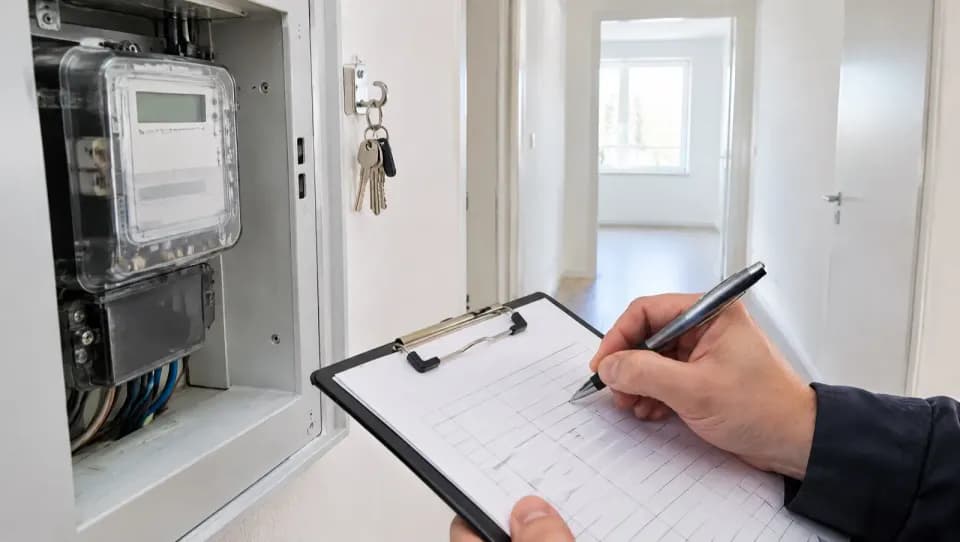
The date of handing over the unit is written into the deed — often a few days or weeks after it is signed, once the whole price reaches your account. When handing over the keys, draw up a handover protocol: the condition of the unit, the fittings, the number of keys and the readings of all meters (electricity, gas, water, heat). On that basis you settle with utility providers and terminate the contracts or transfer them to the buyer.
Inform the community manager or the cooperative of the change of owner and pay the charges up to the day of handover. If the flat being sold had a mortgage, make sure that after repayment the bank gives consent to deleting it and the application goes to the land registry court — a clean register is also in your interest.
Step 10: tax on selling a flat and PIT-39
A sale is a source of income if it takes place before 5 years have passed, counting from the end of the year in which you acquired the flat (Art. 10(1)(8) of the PIT Act). A flat bought in 2022 can therefore be sold without tax from 1 January 2028. With an inheritance, the year of acquisition by the deceased counts — details in the article Tax on selling an inherited flat (in Polish). When selling before the deadline you pay 19% on income and file PIT-39 from 15 February to 30 April of the following year (Art. 30e and Art. 45(1a)(3)).
Example: a flat bought in 2022 for PLN 600,000, with documented acquisition costs totalling PLN 615,000, is sold in 2026 for PLN 820,000. Assume a broker's commission of 2% + VAT, i.e. PLN 20,172 (an assumption of the example). Revenue = 820,000 − 20,172 = PLN 799,828; income = 799,828 − 615,000 = PLN 184,828; 19% tax = about PLN 35,117.
If within 3 years from the end of the year of sale you spend the money on your own housing purposes, the income is exempt proportionally (Art. 21(1)(131)). You put PLN 500,000 towards a new flat from a developer: exempt is 184,828 × 500,000 / 799,828 ≈ PLN 115,542, taxed remains about PLN 69,286, and the tax falls to about PLN 13,164. By spending the whole revenue you pay nothing. How to count costs and valorisation is described in the article Tax on selling a flat within 5 years, and the conditions of the relief in the text Housing relief (ulga mieszkaniowa).
Selling in order to buy a new flat?
This is a common scenario: selling the old flat finances buying a new one, and spending on a new home lets you use the housing relief. The hardest part is matching the dates — we describe four ways to do it in the article How to buy a new flat by selling the old one (in Polish). With a flat under construction, payments are spread in a schedule, which makes combining the two transactions easier. You will find current offers in the catalogues of new flats in Warsaw and new flats in Wrocław — according to the TM Invest offer as of 27 September 2026, that is over 4.3k available units in 118 projects in total.
Read also (materials in Polish):
- The energy performance certificate
- An exclusive or an open brokerage agreement
- How long selling a flat takes
- What after selling a flat – a checklist
- Selling a flat with a tenant
Frequently asked questions
Who pays the notary when a flat is sold?
The regulations do not settle this — the parties may agree freely. Customarily the buyer pays the notary fee, the court fees for the ownership entry and PCC. The seller usually covers the cost of their own documents and any deletion of a mortgage.
What documents are needed to sell a flat?
The basic ones are an ID card, the land register number, the acquisition document (a notarial deed, a decision declaring acquisition of an estate) and the energy performance certificate. The notary or the buyer's bank may ask for certificates from the community or cooperative. The full list is in our article on documents for selling a flat.
Can you sell a flat without an energy certificate?
The deed can be signed, but the seller is then not performing a statutory obligation and is exposed to a fine — the notary must instruct them about it. The buyer cannot waive the right to receive the certificate, so it is better to prepare it before listing the offer.
How long does selling a flat take?
The formalities from the preliminary agreement to the deed usually take from a few weeks to two or three months, mainly because of the buyer's mortgage. Finding a buyer takes the longest — what decides here is the price relative to the market and the quality of the offer.
Do you have to pay tax on selling a flat after 5 years?
No. If 5 years have passed from the end of the year of acquisition, the sale is not a source of income under PIT and you do not file PIT-39. Before that date you pay 19% on income, unless you put the money towards your own housing purposes under the relief.
Summary
Selling a flat is a process in 10 steps in which two moments matter most: diligent preparation of the documents and the price at the start, and a correct tax settlement at the end. The notary costs and PCC are customarily borne by the buyer, and what remains on your side is the energy certificate, the documents, a possible commission and — with a sale before 5 years have passed — the tax, which the housing relief can reduce even to zero.
Want to sell your flat smoothly and without surprises? Order a valuation and a sale plan — we will help prepare and carry out the sale. If you are buying a new flat with the sale proceeds, use our help buying from a developer — most often without a commission for the buyer, the fee is usually paid by the developer.
Legal status as of September 2026. The calculations are indicative, and the article is not tax or legal advice — for an individual matter consult a notary or a tax specialist.
Sources
- Act – Civil Code, consolidated text Dz.U. 2026 item 795 (in Polish) – Art. 158, 389, 390, 394
- Act on the energy performance of buildings, consolidated text Dz.U. 2024 item 101 (in Polish) – Art. 3, 11, 13, 14, 41
- Regulation on maximum notary fees, consolidated text Dz.U. 2024 item 1566 (in Polish) – § 3, § 6(19)
- Act – Notary Act, consolidated text Dz.U. 2026 item 614 (in Polish) – Art. 5
- Act on tax on civil-law transactions, consolidated text Dz.U. 2026 item 191 (in Polish) – Art. 4, 7, 9(17)
- Act on court costs in civil cases, consolidated text Dz.U. 2025 item 1228 (in Polish) – Art. 42, 46
- Act on personal income tax, consolidated text Dz.U. 2026 item 592 (in Polish) – Art. 10, 21, 30e, 45
- Podatki.gov.pl – disposal of real estate (in Polish)
- NBP – BaRN Residential Property Price Database, flat prices (Q2 2026)
- Flat prices: TM Invest project catalogue, as of 27 September 2026