











Air Conditioning in a Block of Flats in Poland 2026 – Owners' Association Consent, Installation Cost, Rules
 Author: Tacjana MasiukiewiczFinishing and fitting out~14 min read
You can install air conditioning in a flat in a block, but an outdoor unit on the facade or balcony usually requires the consent of the owners' association or the building manager, because the external wall is as a rule common property. For a typical split air conditioner you most often need neither a building permit nor a notification to the district office (starostwo) – the exception is listed (heritage) buildings. Below we explain the rules, show indicative installation prices as of September 2026 and calculate what the electricity costs.
Key facts
- Common property is made up of the parts of the building that do not serve exclusively the owner of a unit (art. 3 para. 2 of the Act on ownership of premises) – the facade is among them, so ask the board for consent before drilling.
- Installing technical equipment up to 3 m in height and installations (other than gas ones) requires no permit or notification (art. 29 para. 4 of the Construction Law); in a building on the register of monuments a building permit is needed.
- Only a company with a certificate for businesses and an installer with a personnel certificate may install an air conditioner with a fluorinated refrigerant (art. 20 and 29 of the F-gas Act).
- A 2.5–3.5 kW split unit with basic installation costs an indicative PLN 3 600–9 000, depending on the class of the unit (company price lists, September 2026).
- The average electricity price with distribution for households in 2025 was, according to URE (the Energy Regulatory Office), PLN 0.9198/kWh – a cooling season for one room usually costs a few hundred zloty, not several thousand.
Air conditioning in a block – do you need the owners' association's consent?
Your unit is your property, but the external walls, balcony structure, roof and insulation belong to the common property. The Act on ownership of premises defines it as the land and the parts of the building and equipment that do not serve exclusively the owners of units (art. 3 para. 2). Every owner may use it in line with its purpose, but in a way that does not hinder others' use (art. 12 para. 1 and art. 13 para. 1).
The Act does not mention air conditioning expressly. There is therefore no single rule on whether the board alone gives consent (an act of ordinary management, art. 22 para. 1) or an owners' resolution is needed (an act exceeding ordinary management, art. 22 para. 2–3). In practice many associations regulate this in the house rules or in a separate resolution: it sets where the outdoor unit may be hung, how to run the pipes and the condensate drain and who is liable for damage to the facade. That is why the first step is a letter to the board or manager with a description of the installation place, a photo of the facade and the data sheet of the unit.
In a new block the board is often initially exercised by a company named by the developer in the sale contracts (the Act allows the manner of management to be set in the contract, art. 18 para. 1). Ask it whether the building already has rules for installing air conditioning – some developments have places for outdoor units set out in the design, e.g. on the balcony behind the balustrade or on the roof.
Outdoor unit on the balcony or on the facade?
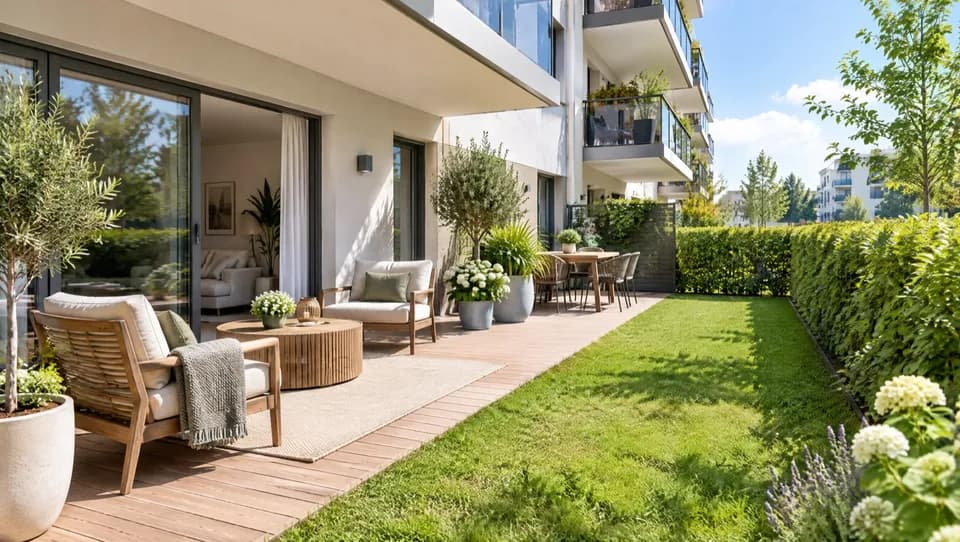
A unit placed on the balcony floor (on anti-vibration feet) usually interferes with the facade less than brackets bolted to the wall – only an opening for the pipes is made in the masonry. Even so, the balcony is not entirely "yours": the balcony slab and balustrade affect the building's appearance and structure, and boards treat them differently. What is allowed on a balcony and terrace without consent we describe in the article Balcony, terrace and garden in a new flat. Installation on a wall above the ground floor often requires a cherry picker or rope-access worker, which raises the cost.
Installing air conditioning in a block – building rules and F-gases
The Construction Law (consolidated text Dz.U. 2026 item 524) exempts from a building permit and from notification, among others, installing on structures technical equipment up to 3 m high, heat pumps and installations inside and outside an occupied building except gas ones (art. 29 para. 4 point 3 letters a, c and d). A typical split air conditioner falls within these exemptions, so you file nothing at the district office.
The exception concerns listed buildings. Works on a structure entered in the register of monuments require a building permit, and in an area entered in the register – notification; in both cases with the permission of the voivodeship monuments conservator (art. 29 para. 7). New blocks rarely stand in such a zone, but for developments in historic city centres it is worth checking.
The second group of rules concerns the refrigerant. The Act on substances that deplete the ozone layer and on certain fluorinated greenhouse gases (consolidated text Dz.U. 2020 item 2065) requires the installer to hold a personnel certificate (art. 20), and the company that installs, services and decommissions air conditioners for customers – a certificate for businesses (art. 29). Ask for the certificate numbers before signing the contract. A small domestic unit usually does not enter the Central Register of Operators, because the obligation applies to equipment with at least 5 tonnes of CO₂ equivalent of fluorinated gases (art. 19 para. 1).
It is also worth knowing about EU Regulation 2024/573. It bans placing on the market, among others, air-to-air split air conditioners up to 12 kW with gases of GWP 150 or higher from 1 January 2029 (annex IV point 9 letter c). The popular refrigerant R32 has a GWP of 675. The ban concerns the sale of new equipment – an air conditioner bought earlier you can continue to use and service.
Noise and neighbours
The regulation on permissible noise levels in the environment (consolidated text Dz.U. 2014 item 112) sets for multi-family residential areas, for "other facilities and activities", 55 dB by day and 45 dB at night (LAeq). These are norms for an area, not a limit for a single device, but they show the scale. Neighbour disputes are also assessed under art. 144 of the Civil Code: an owner may not disturb the use of neighbouring properties beyond the average measure.
In practice: choose a unit with a low sound power level for the outdoor unit (given on the energy label), place it on anti-vibration pads and do not point the air outlet at a neighbour's window. Drain the condensate to the sewer or by pump – dripping onto the balcony below is one of the most frequent complaints to the manager.
How much does air conditioning in a flat cost in 2026?
The price is made up of the unit, basic installation and surcharges for a more difficult installation route. Below are indicative ranges from company price lists, September 2026 – final prices for an individual customer.
| Item | Indicative cost | Notes |
|---|---|---|
| 2.5–3.5 kW split with installation – budget segment | 3 600–5 000 PLN | basic installation, route of about 3 m |
| 2.5–3.5 kW split with installation – mid range | 5 000–6 500 PLN | quieter units, better efficiency |
| 2.5–3.5 kW split with installation – premium brands | 6 500–9 000 PLN | design, filters, lowest noise |
| Basic installation alone of one unit | 1 400–2 200 PLN net | opening, pipes up to about 3 m, vacuum, leak test, commissioning |
| Installation with a ready installation (prepared by the developer) | about 1 100 PLN net | no drilling and no running of pipes |
| Extra metre of refrigerant pipework | 100–130 PLN net | when the units are far apart |
| Core drilling or a chase in reinforced concrete | 200–220 PLN net | per opening or metre of chase |
| Condensate pump | about 500 PLN net | when there is no fall to the drain |
| Annual service | 200–350 PLN | a warranty condition at many firms |
The VAT rate is a separate topic. In company price lists you meet both 8% for individual customers and 23%; the rate is decided by the contractor on the basis of the nature of the service. The general rules for applying the reduced rate we describe in the article 8% VAT on finishing a flat – with air conditioning, ask the firm which rate it will apply and why.
Example: two rooms in a 2-bedroom flat in Warsaw
The median price of a 2-bedroom flat in our Warsaw offer is PLN 755 824 with a median of 39.4 m² (according to TM Invest offer data as of 27.09.2026). Suppose air conditioning in the living room and bedroom: two mid-range splits at about PLN 5 500 each, plus 2 metres of extra installation (about PLN 280) and a condensate pump for one unit (about PLN 540). Together about PLN 11 800, i.e. about 1.6% of the flat's price and about PLN 300 per 1 m². If the developer prepared the installation for air conditioning, fitting each unit can be several hundred zloty cheaper and chasing freshly painted walls is avoided.
Looking for a flat and want to plan air conditioning from the start rather than chase the walls after moving in? We will help you choose a flat from a developer and ask about preparation of the installation, a place for the outdoor unit and the association's rules before the contract.
How much electricity does air conditioning use?
The cost is simple to calculate: average power draw (kW) × hours of operation × price of 1 kWh. A cooling capacity of 2.5–3.5 kW is not the same as electricity draw – a modern split uses several times less energy than the cooling it delivers, and once the room is cooled it runs at low power. We assume an average draw of 0.4–0.6 kW (our own assumption, depending on the unit and sun exposure) and the average URE price for 2025: PLN 0.9198/kWh with distribution.
| Scenario | Consumption in the season | Electricity cost |
|---|---|---|
| Bedroom: 0.4 kW × 8 h × 60 days | 192 kWh | about 177 PLN |
| Living room: 0.6 kW × 6 h × 90 days | 324 kWh | about 298 PLN |
| Both rooms together | 516 kWh | about 475 PLN |
Air conditioning in a new flat from a developer
Developers increasingly offer "preparation for air conditioning": refrigerant pipes and a power cable hidden in the wall and a condensate drain. This is not, however, the standard. In the data of our offer (118 developments in Warsaw and Wroclaw, as of 27.09.2026) air conditioning does not appear as an amenity in any development – most often listed are a lift, a parking space and storage units, and 22 developments have smart home. Ask about preparation of the installation directly and check the finishing standard in the information prospectus.
If you are buying a flat under construction – and in our offer that is 57 of the 118 developments – you can often order the air conditioning installation as a buyer-requested layout change before the walls are plastered. How it works and what it costs we describe in the article Layout changes with the developer. You will find current developments in the catalogue: new flats in Warsaw and new flats in Wroclaw.
Drilling the facade and the developer's warranty (rekojmia)
The developer is liable for defects of the unit and the building under the statutory warranty (rekojmia) for 5 years from handover (art. 568 § 1 of the Civil Code). It is not, however, liable for damage caused by someone else's interference. If a firm drills through the insulation without sealing it and the wall starts to leak, a dispute over who pays for the repair can be difficult. Before installation, read the unit's user manual and the warranty conditions, photograph the facade, and in the contract with the installer write in the duty to seal the wall penetration tightly. More on reporting defects in the article Developer warranty (rekojmia).
It is best to plan installation after handover but before painting and furnishing – together with other work in the first weeks after moving in. Our schedule for finishing a flat step by step and checklist for moving into a new flat will help.
Frequently asked questions
Do you need the owners' association's consent for air conditioning in a block?
If the outdoor unit is to hang on the facade or pipes are to pass through the external wall, you interfere with common property and should obtain the board's or association's consent. Whether a board decision is enough or a resolution is needed depends on the rules and resolutions of your association – ask about it in writing.
Does installing air conditioning require notification at the district office?
Usually not. The Construction Law exempts from a permit and notification the installation of technical equipment up to 3 m in height, heat pumps and installations other than gas ones (art. 29 para. 4). The exception is a building entered in the register of monuments, where a building permit and the conservator's consent are needed.
How much does air conditioning in a flat cost with installation?
A 2.5–3.5 kW split air conditioner with basic installation costs an indicative PLN 3 600 in the budget segment up to about PLN 9 000 for premium units (company price lists, September 2026). Surcharges for a longer pipe route, drilling in reinforced concrete or a condensate pump can add from a few hundred to over a thousand zloty.
Can anyone install air conditioning?
No. Installing air conditioners with fluorinated gases requires a personnel certificate, and a company providing such services to customers must hold a certificate for businesses. Installation "through a friend" by a person without qualifications breaches the rules and usually means loss of the manufacturer's warranty.
Is an air conditioner on the balcony legal?
Yes, if the board or association agrees to it and if the unit does not breach the building's rules – e.g. it does not protrude beyond the balustrade, is not excessively noisy and does not drip onto the balconies below. Many associations prefer the balcony precisely because installation needs no brackets on the facade.
How much does electricity for air conditioning cost per month?
With an average draw of 0.6 kW, 6 hours of operation a day and a price of about PLN 0.92/kWh, that is about PLN 100 a month for one room in a hot month. In cooler weeks the cost is much lower, because the unit runs for less time and at lower power.
Summary
Air conditioning in a block is above all a question of the association's consent and a good contractor, not of building formalities. Before you order installation, ask the board about the rules, check the firm's certificates and make sure the wall penetration is sealed tightly. The cost of one room is usually PLN 3 600–9 000 with installation and a few hundred zloty for electricity in the season. Cheapest of all is an installation planned at the construction stage.
Want to buy a flat in which air conditioning is easy to install – with a prepared installation or a place for the outdoor unit? Use our help with buying a flat from a developer. We have been on the market since 2016, and for the buyer we work in most cases with no commission – the developer usually pays our fee.
Legal position as of September 2026. Prices and calculations are indicative and are not legal or tax advice. The rules for installation in a specific building are set by the association's resolutions and house rules.
Sources
- Act on ownership of premises – consolidated text Dz.U. 2026 item 232 (art. 3 para. 2, art. 12 para. 1, art. 13 para. 1, art. 18 para. 1, art. 22).
- Construction Law – consolidated text Dz.U. 2026 item 524 (art. 29 para. 4 point 3 letters a, c, d; art. 29 para. 7).
- Act on substances that deplete the ozone layer and on certain fluorinated greenhouse gases – consolidated text Dz.U. 2020 item 2065 (art. 19 para. 1, art. 20, art. 29).
- Regulation (EU) 2024/573 on fluorinated greenhouse gases – annex I (GWP of HFC-32) and annex IV point 9.
- Regulation of the Minister of the Environment on permissible noise levels in the environment – consolidated text Dz.U. 2014 item 112 (annex, table 1).
- Civil Code – consolidated text Dz.U. 2026 item 795 (art. 144, art. 568 § 1).
- URE – average electricity price for households (2025: PLN 0.9198/kWh, information of the President of URE no. 15/2026).
- Flat prices and development amenities: TM Invest investment catalogue, as of 27.09.2026.